Updates

  1. Person pages list letters, writing, profiles and links as sortable tables with filters, and show each person's companies as links; Fund letters show each letter's description in its own column.
  2. Experts show a checked job title and a short description of each person; 30 more people have photographs.
  3. Every company, fund, university and publication the experts work for has a page listing the people there.
  4. Fund letters show each letter's thesis and filter by it; 225 person pages list the essays, columns and newsletter issues the person wrote.
  5. Person pages list every essay and newsletter issue a person wrote, and their own books as a table in List view.
  6. Recommends shows the five largest kinds of book and the rest under More; browse pictures load sooner.
  7. Podcasts and talks link the original episode, filter by Audio and video or Press, and list each publisher once.
  8. Pages are wider, Recommends has List and Grid, and a filter clicked again turns off.
  9. Book cards sit in a ruled grid with Open Library and Goodreads links and each book's one-line note.
  10. Funds is now Investors; each investor's styles are buttons that filter the table.
  11. Podcasts and talks on a person's page filter by year and publisher and show as a list or a grid of pictures.
  12. Quotes show only people's own words: 472 summaries written by list sites are gone.
  13. Country pages open from Browse again, and every link on the shelf lands on a page.
  14. Subject and person pages show their sections as tabs, and each book appears once on a person's page.
  15. Book cards show the quote, who said it and the source; grids show five cards to a row.
  16. On a phone, a menu holds the sections, search, Updates, Feedback and dark mode.
  17. Feedback takes a screenshot of the page with no browser prompt, opens a screenshot full size when you click it, and clears itself once sent.
  18. Book cards are centred, search names the topic each book sits in, and any text cut short shows whole on hover.
  19. Search groups its results by kind: people, companies, geographies, subjects, topics, books, funds, fund letters and papers.
  20. The Books table lists who recommended each book by name, and the browser tab names the section you are in.
  21. Feedback can take a screenshot of the page, or one you paste or choose, and opens in the corner beside Updates.
  22. Each rail button reopens its section where you left it, and Browse, Table and People show on every book and subject page.
  23. Filters grey out choices that hold nothing instead of hiding them, and Books › People filters by authors or recommenders.
  24. Feedback takes a subject line and up to three screenshots.
  25. Biographies are grouped by the person they are about: 41 new pages, from Abraham Lincoln to Lee Kuan Yew.
  26. Sport splits into 23 sports, and Religion into one topic per faith.
  27. Book lists show as cards: the cover, one recommendation quote and every recommender by name.
  28. Seventeen subjects that had two or three pages under different names now have one page each.
  29. Every page lists its Experts as authors and recommenders, with a link to them on the Experts tab.
  30. Economics, Financial history, Financial panics and Accounting are subjects of their own, with one page per financial crisis.
  31. Book, person and subject pages open inside the app, so the tabs stay in view.
  32. 996 more book covers, and photographs or logos for 227 more people and companies.
  33. Books › Browse shows every subject as cards, and the rail holds Fund letters, Papers, Experts, Books and Funds.
  34. Every topic over 150 books splits into narrower topics, each with a page of its own.

Send feedback

What is it?
Screenshots, up to 3 (optional)
or paste one with Ctrl+V

We use your email only to reply to you.

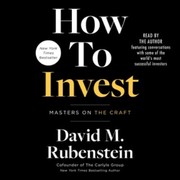
How to Invest

How to Invest

David M. Rubenstein
2022
T3 1 pages · about 1m to read Open Librarygoodreads

Interviews with Marks, Dalio, Simons, Schwarzman and other investors.

Summary

David Rubenstein, co-founder of Carlyle, interviews roughly two dozen investors across asset classes and prints the conversations with short introductions. The subjects include Larry Fink, Ray Dalio, Seth Klarman, Stan Druckenmiller, Jim Simons, Mary Erdoes, Marc Andreessen, Sandra Horbach, John Paulson and Michael Moritz, organised by category: public equities, distressed debt, hedge funds, private equity, venture capital, real estate, credit and infrastructure.

The book's function is orientation rather than instruction. Each chapter establishes what a given asset class actually involves, how the practitioners think about sourcing and risk, and how they describe their own edge. Rubenstein asks consistent questions about how the subject entered the business, what mistakes they made, and what they look for in people they hire. The answers are more candid than a conference panel and less detailed than a serious methodological account.

The limitation is survivorship. Every subject has a long record of success, and none is asked hard questions about fee structures, benchmark selection or the role of luck in their results. Rubenstein is a peer rather than a journalist, and the tone reflects that. Readers wanting an argument about how to invest will not find one; readers wanting a competent map of who does what in institutional asset management, and in the words of the people doing it, will.

Key takeaways 6

  1. Investment approaches that work are usually narrow, and almost every subject describes deliberately staying inside a defined competence.
  2. Most of the interviewees attribute their entry into the business to accident rather than to plan.
  3. Private market returns depend more on sourcing proprietary deals than on analysis of deals everyone sees.
  4. Successful managers describe institutional structures that let them hold positions through drawdowns, which is a capital-base question rather than an analytical one.
  5. Several subjects state that they hire for curiosity and independence rather than for finance credentials.
  6. Rubenstein argues that individual investors should concentrate on low-cost index exposure and treat the alternatives described here as institutional products.

Who should read it

Readers new to institutional investing who want a survey of asset classes and practitioners before choosing where to specialise.

About David M. Rubenstein

Co-founder and co-chairman, The Carlyle Group, 1987-present; host, The David Rubenstein Show

Built one of the largest private equity firms and has become the most prolific interviewer of investors and leaders, turning those conversations into a widely read book series.

Similar books 6

Chosen by shared topics, the entries that hold them, and the people who recommended both.

David M. Rubenstein · 2020

Interviews with leaders such as Jeff Bezos on how they lead.

Josh Kosman · 2009

Critical account of leverage and portfolio company outcomes across the big firms.
Eileen Appelbaum, Rosemary Batt · 2014

What private equity does to companies, workers and investor returns, critically.

David M. Rubenstein · 2021

Subtitled Dialogues on a Dream.

David M. Rubenstein · 2019

Conversations with leading historians.

Where it sits in the reference 2

Investors
Companies

Topics

Investing