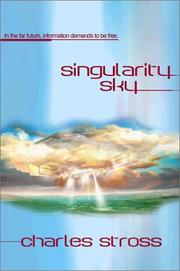
Singularity Sky
A space opera set centuries after an AI, the Eschaton, began to police causality.
Summary
Charles Stross's first novel, published in 2003, is set centuries after a technological singularity produced the Eschaton, an artificial intelligence descended from humanity that polices any violation of causality within its light cone. The New Republic, an interstellar empire modelled on Imperial Russia, restricts technology to roughly nineteenth-century levels. The book begins when the Festival, a posthuman collective of artificial and uploaded minds, arrives over the colonial world of Rochard's World and drops telephones from the sky, granting any wish in exchange for information it finds entertaining.
Local revolutionaries ask for cornucopia machines, and the colony's economy and social order break down. The Republic sends its navy, which plans to use a closed timelike path to arrive soon after the Festival, risking the Eschaton's retaliation. Aboard the flagship are two outside agents, the diplomat Rachel Mansour and the engineer Martin Springfield, sent to prevent a causality violation. Reviewers note that long stretches of the book follow the fleet's voyage, and that its ideas outnumber its action.
Key takeaways 4
- A society that bans technology cannot survive contact with a power that hands out anything on request.
- Free access to manufacturing machines destroys an economy and social order built on scarcity.
- Stross uses an empire modelled on Tsarist Russia to show the reaction of a conservative state to sudden abundance.
- The Eschaton's ban on time travel shapes every military decision in the book.
Who should read it
Science-fiction readers interested in post-singularity economics and politics, and readers of Ken MacLeod or Greg Egan.
Who recommended it 1 · 1 direct
Similar books 6
Chosen by shared topics, the entries that hold them, and the people who recommended both.
Ancient machines that destroy intelligent life wake from long sleep.
Recommended by: Marc Andreessen
A science fiction novel of first contact after alien objects surround the Earth.
Recommended by: Marc Andreessen
A science fiction novel of a knight on a primitive world and a resurrected cyborg.
Recommended by: Marc Andreessen
A science fiction mystery of an archaeologist on an uninhabitable future Earth.
Recommended by: Marc Andreessen
A science fiction novel of a domed city on a hostile planet ravaged by a plague.
Recommended by: Marc Andreessen
A science fiction adventure among space colonies, after a disaster.
Recommended by: Marc Andreessen