Updates

  1. Person pages list letters, writing, profiles and links as sortable tables with filters, and show each person's companies as links; Fund letters show each letter's description in its own column.
  2. Experts show a checked job title and a short description of each person; 30 more people have photographs.
  3. Every company, fund, university and publication the experts work for has a page listing the people there.
  4. Fund letters show each letter's thesis and filter by it; 225 person pages list the essays, columns and newsletter issues the person wrote.
  5. Person pages list every essay and newsletter issue a person wrote, and their own books as a table in List view.
  6. Recommends shows the five largest kinds of book and the rest under More; browse pictures load sooner.
  7. Podcasts and talks link the original episode, filter by Audio and video or Press, and list each publisher once.
  8. Pages are wider, Recommends has List and Grid, and a filter clicked again turns off.
  9. Book cards sit in a ruled grid with Open Library and Goodreads links and each book's one-line note.
  10. Funds is now Investors; each investor's styles are buttons that filter the table.
  11. Podcasts and talks on a person's page filter by year and publisher and show as a list or a grid of pictures.
  12. Quotes show only people's own words: 472 summaries written by list sites are gone.
  13. Country pages open from Browse again, and every link on the shelf lands on a page.
  14. Subject and person pages show their sections as tabs, and each book appears once on a person's page.
  15. Book cards show the quote, who said it and the source; grids show five cards to a row.
  16. On a phone, a menu holds the sections, search, Updates, Feedback and dark mode.
  17. Feedback takes a screenshot of the page with no browser prompt, opens a screenshot full size when you click it, and clears itself once sent.
  18. Book cards are centred, search names the topic each book sits in, and any text cut short shows whole on hover.
  19. Search groups its results by kind: people, companies, geographies, subjects, topics, books, funds, fund letters and papers.
  20. The Books table lists who recommended each book by name, and the browser tab names the section you are in.
  21. Feedback can take a screenshot of the page, or one you paste or choose, and opens in the corner beside Updates.
  22. Each rail button reopens its section where you left it, and Browse, Table and People show on every book and subject page.
  23. Filters grey out choices that hold nothing instead of hiding them, and Books › People filters by authors or recommenders.
  24. Feedback takes a subject line and up to three screenshots.
  25. Biographies are grouped by the person they are about: 41 new pages, from Abraham Lincoln to Lee Kuan Yew.
  26. Sport splits into 23 sports, and Religion into one topic per faith.
  27. Book lists show as cards: the cover, one recommendation quote and every recommender by name.
  28. Seventeen subjects that had two or three pages under different names now have one page each.
  29. Every page lists its Experts as authors and recommenders, with a link to them on the Experts tab.
  30. Economics, Financial history, Financial panics and Accounting are subjects of their own, with one page per financial crisis.
  31. Book, person and subject pages open inside the app, so the tabs stay in view.
  32. 996 more book covers, and photographs or logos for 227 more people and companies.
  33. Books › Browse shows every subject as cards, and the rail holds Fund letters, Papers, Experts, Books and Funds.
  34. Every topic over 150 books splits into narrower topics, each with a page of its own.

Send feedback

What is it?
Screenshots, up to 3 (optional)
or paste one with Ctrl+V

We use your email only to reply to you.

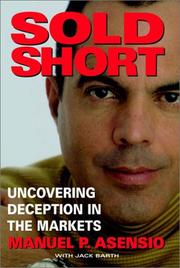
Sold Short

Sold Short

Manuel P. Asensio, Jack Barth
2001
T3 264 pages · about 4h 24m to read Open Librarygoodreads

An activist short seller's account of his campaigns.

Summary

Manuel Asensio ran a small brokerage and research firm that took short positions in companies it publicly accused of fraud, and this account covers his campaigns and the responses to them. He is unusual among short sellers in having published his research under his own name and having sought publicity for it.

The campaigns he describes include Diana Corporation, Solv-Ex, Turbodyne, Hemispherx Biopharma and PolyMedica, among others. His method was to research a company's claims, take a short position, publish a detailed report asserting fraud or misrepresentation, and press regulators and journalists to act. He describes the responses: litigation against him, complaints to regulators, personal harassment, and pressure on his clearing broker.

Asensio's argument is that public short selling with published research is a legitimate and necessary market function, that the regulatory and legal system is structured to favour the accused company over the accuser, and that market makers and brokers face commercial pressure not to facilitate short positions. He is a partisan writing about his own record, and the record itself is mixed: some of his targets were subsequently shown to have serious problems and others were not, and he faced regulatory sanction himself. Readers should treat it as one practitioner's account of a contested activity rather than as a settled record.

Key takeaways 6

  1. Publishing short research under one's own name invites litigation, regulatory complaint and personal harassment from the target.
  2. The legal and regulatory system provides an accused company with remedies against its accuser that the accuser does not have.
  3. Short sellers depend on clearing brokers and stock lenders who face commercial pressure from the companies concerned.
  4. Asensio argues that public accusation is more effective than quiet positioning because it forces a company to respond in writing.
  5. Companies with fraudulent claims respond to research with litigation rather than with evidence, which is itself informative.
  6. Asensio's own record was mixed and he faced regulatory sanction, so his account should be read as partisan.

Who should read it

Investors interested in activist short selling and in the practical and legal obstacles it faces, treating the account as one interested party's version.

Similar books 6

Chosen by shared topics, the entries that hold them, and the people who recommended both.
Daniel A. Strachman · 2004

Tiger Management, the firm that set the long-short template.

Recommended by: Mohnish Pabrai
Maneet Ahuja · 2012

Profiles of the hedge fund managers who ran their strategies at scale after 2008.
Lois Peltz · 2001

Profiles of the hedge fund managers who rose above thousands of others in a decade.

Recommended by: Mohnish Pabrai

Where it sits in the reference 1

Investment styles

Topics

InvestingBiography and MemoirInvestors, Traders and GamblersHedge fund managers