
Lisha Li
Joined Andreessen Horowitz after eight years running Rosebud AI, an AI coding platform for games, which she founded.
 Andreessen Horowitz
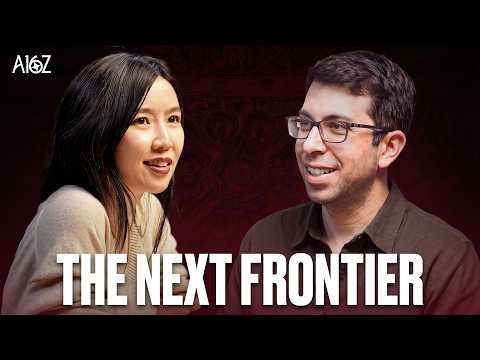
| Can Open Models Keep Up With the AI Frontier? | Nathan Lambert | The a16z Show | 2026-10-14 | a16z Partner Lisha Li sits down with AI researcher and Trillium founder Nathan Lambert to ask how durable the gap really is between frontier AI labs and open models. Nathan argues that OpenAI and Anthropic have structural advantages in compute, capital, and the ability to pioneer new training paradigms, but open-model labs, particularly in China, have proven remarkably capable of following close behind. They unpack how much of that comes from distillation versus technical talent, why compute remains a major constraint, and how data, RL environments, and post-training are increasingly shaping model progress. They also discuss Nathan’s new nonprofit research lab, Trillium, and its plans to open up parts of AI research that are increasingly difficult to study from the outside. That includes releasing RL environments and documenting how AI is actually being used to automate AI research, with the goal of demystifying recursive self-improvement and giving researchers and policymakers a clearer picture of what frontier systems can and cannot do. | |
| OpenAI Researchers on the Future of Mathematical Reasoning | The a16z Show | 2026-09-08 | a16z Infra Partner Lisha Li sits down with OpenAI mathematicians Mehtaab Sawhney and Mark Sellke to discuss how quickly AI’s mathematical capabilities are advancing, what recent results reveal about model reasoning, and what happens when AI begins making progress on problems mathematicians have struggled with for decades. Mehtaab and Mark unpack several recent results from OpenAI’s models, including advances in sphere packing and the construction of a non-sofic group. They explain why the surprising part isn’t simply that models can search more possibilities or work longer than humans: in many cases, the reasoning traces look remarkably similar to the work of an expert mathematician, including choosing promising approaches, backtracking when they fail, and combining ideas from across the literature. They also explore what this means for mathematics itself: how the role of human taste and judgment may change, whether AI could produce far more mathematics than humans can absorb, and why models that accelerate discovery may also make sophisticated results easier to understand. | |
| Daniel Litt: The Mathematician's Guide to AI | The a16z Show | 2026-09-01 | a16z’s Lisha Li sits down with Daniel Litt, Assistant Professor of Mathematics at the University of Toronto, to unpack AI's rapid progress in mathematics, what today's frontier models can actually do, and what they're still missing about the way mathematicians think. Daniel explains why some recent AI-generated results are genuinely impressive, including an autonomous solution to the Erdős unit distance problem, but argues that solving problems is only one part of mathematics. Today's models can grind through calculations, combine known techniques, and search enormous spaces, but still struggle with intuition, theory building, identifying the right questions, and developing the kind of big-picture understanding that drives much of mathematical progress. Lisha and Daniel also explore how AI is already changing mathematical research, why an explosion of AI-generated papers could distort academic incentives, and what happens if researchers outsource the work of thinking rather than use AI to deepen it. Ultimately, they ask a question that extends far beyond mathematics: as AI gets better at intellectual work, how do we make sure humans keep getting better at thinking too? | |
| What Today’s Best Models Still Can’t Do in Math | The a16z Show | |||
| Can Open Models Keep Up With OpenAI and Anthropic? | Nathan Lambert | The a16z Show | |||
| Inside OpenAI’s Breakthroughs in Mathematical Reasoning | The a16z Show |
 TCan Open Models Keep Up With the AI Frontier? | Nathan LambertThe a16z Show · 2026-10-14TOpenAI Researchers on the Future of Mathematical ReasoningThe a16z Show · 2026-09-08TDaniel Litt: The Mathematician's Guide to AIThe a16z Show · 2026-09-01
 TWhat Today’s Best Models Still Can’t Do in MathThe a16z Show
 TCan Open Models Keep Up With OpenAI and Anthropic? | Nathan LambertThe a16z Show
 TInside OpenAI’s Breakthroughs in Mathematical ReasoningThe a16z Show