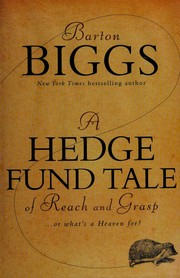
A Hedge Fund Tale of Reach and Grasp: Or What's a Heaven For
Wiley; some listings date it 2011. Open Library unreachable during build
Summary
Biggs, formerly of Morgan Stanley and later a hedge fund manager, wrote this novel about a young man from a modest background who works his way into the investment business, builds a successful hedge fund, and then loses it.
The fictional frame carries the content Biggs wanted to convey about the industry: how a fund is raised and marketed, the relationship between managers and their investors, the pressure of monthly and quarterly performance reporting, the effect of leverage on a manager's decisions, the psychology of a drawdown, the behaviour of fund of funds allocators who add capital after good periods and withdraw after bad ones, and the way a manager's personal life and judgement deteriorate together under sustained stress.
Biggs was a genuine industry insider and the detail about how the business operates is accurate, particularly on capital raising, on the terms and structures, and on the specific ways that investor behaviour forces managers into decisions they know are wrong.
As a novel it is weak. The characters are types, the prose is functional, and the plot follows a predictable arc. The reference has not verified whether specific episodes are drawn from actual events. Its value is as an accessible description of how the hedge fund business actually works for someone who has not been inside one, and as a portrait of the psychological pressures the structure creates. Biggs' non-fiction, particularly Hedgehogging, covers the same ground more directly.
Key takeaways 7
- Hedge fund investors add capital after strong periods and withdraw after weak ones, which forces managers to trade against their own judgement at the worst moments.
- Monthly and quarterly performance reporting compresses a manager's effective horizon far below the horizon their strategy requires.
- Leverage changes a manager's decisions before it changes their results, because the possibility of a forced liquidation enters every position decision.
- Raising capital and managing money are different skills, and the business rewards the first at least as much as the second.
- Fund of funds allocators optimise for their own client reporting rather than for the underlying manager's strategy, which transmits short-termism down the chain.
- A sustained drawdown degrades a manager's judgement and personal life together, and the two deteriorations reinforce each other.
- Success in the business attracts capital faster than a strategy's capacity grows, which is what converts good managers into mediocre ones.
Who should read it
Readers who want an accessible portrait of how the hedge fund business and its investor pressures actually work, though Biggs' non-fiction covers it more directly.
About Barton Biggs
Chief global strategist, Morgan Stanley 1973-2003; co-founder, Traxis Partners (1932-2012)
Thirty years of Morgan Stanley global strategy plus Hedgehogging, still the most candid insider account of how hedge fund managers actually behave.
Where it sits in the reference 2
Who recommended it 1 · 1 direct
Similar books 6
Chosen by shared topics, the entries that hold them, and the people who recommended both.