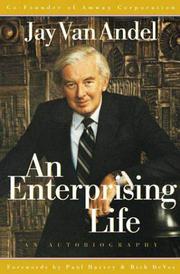
An Enterprising Life
Amway's co-founder's own account; read alongside the criticism.
Summary
The reference has not verified this book in detail; the summary states only what the title, author and subject establish.
Van Andel co-founded Amway with Rich DeVos and wrote this memoir late in life, covering his childhood in the Dutch Reformed community of Grand Rapids, Michigan, the wartime service, the early business ventures with DeVos including a flying school and a sailing venture, the Nutrilite distributorship that taught them direct selling, and the founding of Amway in 1959.
The account combines business history with the philosophical position Van Andel held, which connects free enterprise, individual responsibility and Christian faith into a single argument. He presents Amway as a vehicle for enabling ordinary people to own a business without capital, and argues that the direct selling model removes the barriers of location, education and credentials that keep people out of business ownership.
The business content covers the compensation structure, the product line beginning with a biodegradable cleaner, the international expansion which eventually made Amway larger outside the United States than within it, particularly in Japan, Korea and later China, and the regulatory challenges including the Federal Trade Commission proceeding that concluded in 1979 with rules the company then operated under.
Van Andel also covers his role in Republican politics and in the United States Chamber of Commerce.
This is a founder's memoir presenting his own account, and it does not engage with the substantial criticism of the business model, including the questions about distributor earnings, the tools business through which upline distributors sell motivational materials to their downline, or the experience of participants who lost money. Butterfield's critical account is also in this reference. Read this for the founders' own framing and for the early history.
Key takeaways 7
- Amway was designed to let people own a business without capital, location or credentials, which is the founders' stated purpose.
- The founders learned direct selling as Nutrilite distributors before creating their own company.
- The compensation structure pays bonuses on the purchasing volume of a distributor's recruited organisation.
- International markets, particularly in Asia, eventually became larger for the company than the United States.
- A 1979 Federal Trade Commission proceeding produced rules distinguishing the structure from a prohibited scheme, which the company then operated under.
- The founders connected free enterprise, individual responsibility and religious faith into a single argument that became the company's culture.
- The memoir presents the founders' framing and does not address criticism of distributor earnings or of the tools business.
Who should read it
Readers wanting the founders' own account of Amway's origins and philosophy, read against critical accounts of the model.
Where it sits in the reference 2
Similar books 6
Chosen by shared topics, the entries that hold them, and the people who recommended both.