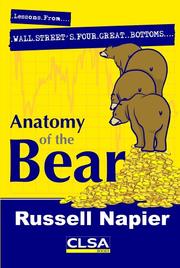
Anatomy of the Bear
Four great bottoms studied through contemporary newspaper reporting.
Summary
Napier examined four occasions when American equities reached their lowest valuations of the twentieth century, in August 1921, July 1932, June 1949 and August 1982, and asked what conditions were present at each. His primary source is contemporaneous reporting in the Wall Street Journal, which he read in full for the periods surrounding each bottom, so the book reconstructs what participants believed at the time rather than what was later established.
The recurring features he identifies are specific. Equities reached bottoms at low cyclically adjusted price-to-earnings ratios and at market capitalisations well below the replacement cost of corporate assets. In each case the bond market recovered before equities, with corporate bond prices and credit spreads improving months ahead of the equity low. Trading volume collapsed and public interest disappeared. Commodity prices stabilised before the equity market did. Economic news at the bottom was uniformly bad and remained bad for a period after prices turned. In three of four cases, the bottom followed a period of monetary or policy change that participants did not initially recognise as significant.
His practical conclusion is that the bottom is identifiable by valuation and by the sequence of markets rather than by improving news, and that waiting for economic confirmation guarantees missing the recovery.
The sample is four observations, which is the fundamental limitation, and Napier is candid about it. He also wrote before 2008, and the 2009 low did not exhibit the deep valuation of his four cases, which either weakens the framework or indicates that 2009 was not a comparable secular bottom. Napier himself has argued the latter. The reconstruction of contemporary opinion is the book's most durable contribution.
Key takeaways 7
- American equities reached their four great bottoms at low cyclically adjusted earnings multiples and below the replacement cost of corporate assets.
- Corporate bond prices and credit spreads improved months before equities turned in every case examined.
- Trading volume and public interest collapsed at the bottom, so the low occurred when almost no one was participating.
- Economic news at each bottom was bad and continued to be bad after prices turned, so waiting for confirmation means missing the move.
- Commodity price stabilisation preceded the equity market bottom in each case.
- The consensus at each bottom held that equities had permanently lost their appeal, which is documented in contemporaneous reporting.
- Four observations are too few to establish a rule, so the framework is a description of past bottoms rather than a predictive method.
Who should read it
Investors trying to identify the end of a long bear market who want documented evidence about what conditions actually prevailed at the historical lows.
Where it sits in the reference 3
Similar books 6
Chosen by shared topics, the entries that hold them, and the people who recommended both.