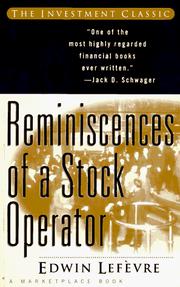
Reminiscences of a Stock Operator
Fictionalised account of Jesse Livermore, serialised in the Saturday Evening Post 1922-23.
Summary
Lefevre published this in 1923 as a fictionalised account of Jesse Livermore, then the most famous speculator in America, presented through the narrator Larry Livingston. It is based on extended interviews and Livermore later acknowledged the accuracy of the portrayal, though it should be read as a novel rather than as a memoir.
The book follows the career from the bucket shops of Boston, where Livingston learned to read the tape and was eventually barred for winning, through repeated cycles of building fortunes and losing them. The 1907 panic, where he made three million dollars in a day shorting, and the 1906 Union Pacific trade before the San Francisco earthquake, are the set pieces.
The trading lessons are stated repeatedly and directly. The big money is made in the big move and not in the fluctuations, which requires sitting still after a position is right. A trader should trade with the general market direction rather than against it. Losses should be cut quickly and positions should be added to only when they show a profit. Tips, inside information and other people's opinions destroy accounts. The market's behaviour, not the trader's reasoning, determines whether a position is correct.
Livingston also describes the manipulation practices of the era, including pool operations and distribution through the tape, which were legal then and are not now. s The book gives no system and its methods depend on tape reading in a market structure that no longer exists. Livermore himself went bankrupt several times and shot himself in 1940, which readers should weigh against the advice. Its durability comes from the psychological description, which traders across a century have recognised.
Key takeaways 8
- The large profits come from holding a correct position through a long move, not from trading the fluctuations within it.
- Most traders lose because they cannot sit still when they are right, and activity feels like work while patience does not.
- A position should be increased only after it shows a profit, and averaging down into a loss is the error that destroys accounts.
- The market's price action, not the trader's analysis, determines whether a position is correct, so a losing position should be closed before the reasoning is re-examined.
- Trading against the general direction of the market produces losses even when the analysis of the individual security is right.
- Tips and inside information are worthless because the person supplying them has their own position and their own reasons.
- Every speculator's mistakes are their own, and blaming manipulation, brokers or news prevents the correction that would improve results.
- There is nothing new in markets, because the same patterns recur whenever the same human responses to money are involved.
Who should read it
Traders and investors who want the classic account of speculative psychology, read as a novel and with awareness that Livermore's own record ended in ruin.
About Edwin Lefevre
Financial journalist and novelist; chronicler of Wall Street, 1901-1943
Reminiscences of a Stock Operator is the primary source nearly every later trading book quotes.
Where it sits in the reference 6
Who recommended it 8 · 7 direct
Similar books 6
Chosen by shared topics, the entries that hold them, and the people who recommended both.