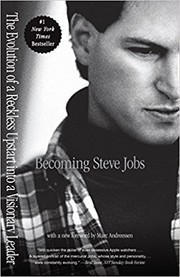
Becoming Steve Jobs
Revisionist counterweight to Isaacson, built on decades of Schlender's interviews.
Summary
Schlender covered Jobs as a journalist for twenty-five years and had extended personal access, and with Tetzeli he argues that Isaacson's biography overweighted the young Jobs and failed to explain how he changed. The book's thesis is that the NeXT and Pixar years, generally treated as a failure period, were where Jobs learned the management skills that made the Apple turnaround possible.
The argument runs through specific changes. At NeXT, Jobs failed commercially and had to accept that his instincts about hardware and pricing were wrong. At Pixar, he worked with Ed Catmull and John Lasseter, who would not accept his interference in creative decisions, and he learned to fund and protect a team rather than direct it. He also learned from Disney's negotiating leverage what a real distribution position was worth.
The book documents the partnership with Tim Cook in detail, arguing that Jobs' willingness to depend on an operations executive he could not replicate was itself the evidence of change. It covers the product decisions of the second Apple period with more attention to the business mechanics than Isaacson gives, including the retail strategy, the music label negotiations and the carrier negotiations for the iPhone.
The access is the problem as well as the strength. Schlender had a personal relationship with Jobs and the book was supported by Cook, Ive and other Apple executives who were unhappy with Isaacson's portrait. It is more favourable and it minimises the cruelty that Isaacson documents. Read the two together rather than either alone.
Key takeaways 8
- The NeXT and Pixar years, usually treated as a failure period, were where Jobs learned to manage rather than only to direct.
- Working with Catmull and Lasseter at Pixar taught Jobs to fund and protect creative teams rather than override them.
- Jobs' partnership with Tim Cook shows a willingness to depend entirely on a capability he did not possess, which he had previously refused to do.
- The Apple turnaround depended as much on operations and supply chain decisions as on product design, which most accounts underweight.
- Failure at NeXT forced Jobs to accept that his instincts about pricing and market positioning had been wrong, which changed how he tested decisions afterwards.
- Jobs negotiated the iPhone carrier terms to preserve Apple's control of the device and its software, which reversed the industry's standard arrangement.
- His management of the music label negotiations required accepting terms and constraints he would not have tolerated a decade earlier.
- The authors argue that the cruelty of the early Jobs diminished substantially, which is the claim readers should weigh against Isaacson's evidence.
Who should read it
Readers who want the counterargument to the Isaacson biography, particularly on how Jobs' management changed and on the business mechanics of the second Apple period.
Where it sits in the reference 2
Who recommended it 8 · 1 direct
Similar books 6
Chosen by shared topics, the entries that hold them, and the people who recommended both.