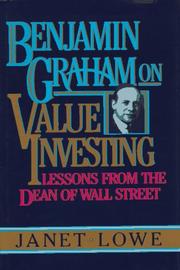
Benjamin Graham on Value Investing
Part life, part method; based on interviews with his circle.
Summary
Lowe wrote a biography of Benjamin Graham covering his childhood poverty after his father's death and his mother's losses in the 1907 panic, his education at Columbia, his career on Wall Street, the losses of 1929 to 1932, the writing of Security Analysis with David Dodd, his teaching at Columbia, the Graham-Newman partnership, and his later years.
The investment content covers the development of his method: the insistence on quantitative criteria that could be applied without forecasting, the margin of safety, the net current asset approach that bought companies below liquidation value, and the Mr Market device. She covers his major investment, GEICO, which he bought in 1948 in a position that violated his own diversification rules and which eventually accounted for more of the partnership's profits than everything else combined, a fact Graham noted with some discomfort about what it implied for his method.
The biographical material covers his personal life, which was complicated, his literary and classical interests, his work on commodity reserve currency proposals, and his late-career statement that detailed security analysis had become unrewarding as the market became better analysed, which is the position most likely to unsettle his followers.
Lowe is a journalist and the book is accessible rather than scholarly. The reference has not verified its specific claims. It is a biography rather than a method book, and readers wanting Graham's approach should read The Intelligent Investor or Security Analysis directly.
Key takeaways 7
- Graham's method was designed to be applied without forecasting, using quantitative criteria that could be checked from published statements.
- The margin of safety, meaning buying substantially below a conservatively estimated value, is the concept Graham considered central to his entire approach.
- His largest single profit came from GEICO, a concentrated position that violated his own diversification rules and produced more than everything else combined.
- Graham's formation included his family's loss of savings in the 1907 panic and his own losses from 1929 to 1932, which shaped the emphasis on capital preservation.
- He concluded late in life that detailed individual security analysis had become unrewarding as the market became better analysed by more participants.
- Treating market quotations as offers from a business partner rather than as information about value is the psychological discipline the method requires.
- The reference has not verified the specific biographical claims in this account.
Who should read it
Investors interested in Graham's life and the origins of his method, with his own books as the source for the method itself.
About Janet Lowe
American financial journalist and biographer of Charlie Munger, Benjamin Graham, Warren Buffett and Bill Miller.
Damn Right! is the standard full-length life of Charlie Munger, built from interviews with Munger, his family and his partners, and the Graham volumes put writings and lectures that had gone out of print back in circulation. The books supply the biographical record behind quotations that circulate everywhere else without sources.
Where it sits in the reference 2
Who recommended it 1 · 1 direct
Similar books 6
Chosen by shared topics, the entries that hold them, and the people who recommended both.