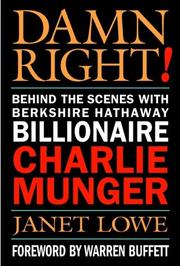
Damn Right! Behind the Scenes with Berkshire Hathaway Billionaire Charlie Munger
The only full biography; written with Munger's cooperation.
Summary
Lowe wrote the biography of Charlie Munger with his cooperation, covering the Omaha childhood, the wartime meteorology training, Harvard Law School, the Los Angeles law practice, the investment partnership he ran from 1962 to 1975, Wesco Financial, Blue Chip Stamps and the partnership with Buffett.
The investment material covers Munger's own partnership record, which produced high returns with far greater volatility than Buffett's, including a decline of over fifty percent across 1973 and 1974 from which it recovered strongly before he closed it. Lowe covers the Blue Chip Stamps acquisitions including See's Candies, which is the transaction that changed Buffett's approach from buying statistically cheap assets to paying fair prices for quality businesses.
The personal material covers the death of his young son from leukaemia, the loss of an eye to a botched cataract operation, his first marriage and divorce, and the family finances during the early years. Lowe documents the intellectual habits that Munger later described publicly, including the reading, the multidisciplinary approach and the insistence on inversion, and covers his philanthropy including the Harvard-Westlake and university buildings he funded and designed.
The book was published in 2000 and predates most of Munger's public prominence, which came through the Wesco meetings and Poor Charlie's Almanack. It is a conventional biography rather than an analysis of his thinking, and readers wanting the latter should go to the Almanack. The account of his own partnership and of its volatility is the material that is hardest to find elsewhere.
Key takeaways 8
- Munger's own investment partnership produced high returns with far greater volatility than Buffett's, including a decline of over fifty percent in 1973 and 1974.
- He closed his partnership in 1975 after recovering from that decline rather than continuing.
- The See's Candies acquisition through Blue Chip Stamps is the transaction that moved Buffett from buying cheap assets to paying fair prices for quality businesses.
- Munger practised law before investing and treated the law practice as a source of capital rather than as a career.
- He read across multiple disciplines continuously and treated this as a professional requirement rather than as an interest.
- He suffered the death of a young son, a divorce and the loss of an eye, which Lowe documents without turning the book into psychology.
- His philanthropy included designing buildings personally, which reflects the same insistence on understanding a subject before acting in it.
- The book predates his public prominence and is a conventional biography rather than an analysis of his thinking.
Who should read it
Investors who want Munger's own investment record and biography, with his thinking better covered in his collected talks.
About Janet Lowe
American financial journalist and biographer of Charlie Munger, Benjamin Graham, Warren Buffett and Bill Miller.
Damn Right! is the standard full-length life of Charlie Munger, built from interviews with Munger, his family and his partners, and the Graham volumes put writings and lectures that had gone out of print back in circulation. The books supply the biographical record behind quotations that circulate everywhere else without sources.
Where it sits in the reference 4
Who recommended it 2 · 2 direct
Similar books 6
Chosen by shared topics, the entries that hold them, and the people who recommended both.