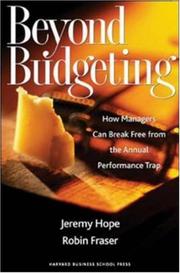
Beyond Budgeting
The case against the annual budget as a control device.
Summary
Hope and Fraser argue that the annual budget process is actively harmful and should be abolished rather than improved, and they document organisations that have done so.
The critique is specific. A budget fixes targets a year or more in advance, which means they are wrong by the time they apply. It creates an incentive to negotiate for easy targets and then to spend the full allocation regardless of need, since underspending reduces next year's budget. It ties compensation to a fixed target, which rewards forecasting negotiation rather than performance and creates pressure to manipulate results at period ends. It centralises decisions about resources, so front-line managers cannot respond to changed conditions. It consumes months of management time producing numbers that are obsolete on arrival.
Their alternative has two components. Adaptive processes replace the fixed annual cycle: targets are set relative to peers, to competitors or to prior periods rather than as fixed numbers; forecasts are rolling and are kept separate from targets and from rewards so that forecasters have no incentive to distort them; resources are made available on demand against a case rather than allocated in advance; and coordination happens through market-like internal mechanisms rather than through a plan. Devolved responsibility is the second component: decisions move to front-line units with accountability for results, which requires a governance framework of principles and boundaries rather than detailed approval.
The evidence is case studies, with Handelsbanken as the central and most-documented example. The Swedish bank abolished budgets in the early 1970s, runs branches as profit centres ranked against each other, and has outperformed its peers on cost-to-income ratio for decades.
The cases are selected and the causal claim is not established, since these organisations differ in many ways from their peers. The relative target and rolling forecast components have been widely adopted while full budget abolition has not.
Key takeaways 7
- A budget fixes targets far enough in advance that they are wrong by the time they apply.
- Negotiating targets rewards forecasting skill and political position rather than performance.
- Departments spend their full allocation regardless of need because underspending reduces the following year's budget.
- Forecasts must be separated from targets and from compensation, or forecasters will distort them.
- Relative targets against peers or competitors adjust automatically to conditions that a fixed number cannot anticipate.
- Resources should be released on demand against a case rather than allocated a year in advance.
- Handelsbanken has operated without budgets since the early 1970s and has outperformed peers on cost efficiency throughout.
Who should read it
Executives and finance leaders who want an argument for replacing the annual budget with relative targets and rolling forecasts, plus the documented cases.
Where it sits in the reference 2
Similar books 6
Chosen by shared topics, the entries that hold them, and the people who recommended both.