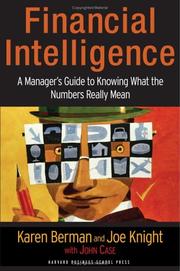
Financial Intelligence
Written for managers who have to read the numbers without an accounting background.
Summary
Berman and Knight wrote this to teach non-financial managers to read and use financial statements. It covers the income statement, balance sheet and cash flow statement, the relationships between them, ratio analysis, return on invested capital, and working capital management.
The distinctive contribution is the emphasis on how much of accounting is estimate and assumption rather than fact. They work through the specific places where judgement enters: revenue recognition timing, allocation of overhead, depreciation schedules and useful life assumptions, allowances for bad debt, inventory valuation method, and accruals generally. Their point to a manager is that the numbers being reported about their unit contain choices, that different choices produce different results, and that understanding which choices were made is part of understanding the result.
The practical sections cover what a manager can actually influence: days sales outstanding, inventory turns, days payable, and the effect of each on cash. They explain why a profitable company can run out of cash and why growth consumes cash, which are the two things operating managers most commonly fail to understand.
The book is written for a general audience and is clear. It is not for investors, who will find it elementary, and it does not cover analysis of a company from outside. Its value is in equipping an operating manager to argue with a finance function on equal terms and to understand how their own decisions appear in the reported numbers. The examples are American and the accounting is United States GAAP.
Key takeaways 7
- Financial statements contain estimates and judgement calls at many points, so two accountants applying the same standards to the same facts produce different numbers.
- Profit and cash are different things, and a profitable and growing company can run out of cash because growth consumes working capital.
- Days sales outstanding, inventory turns and days payable are the working capital levers an operating manager can actually move.
- Return on invested capital is the measure that connects operating decisions to whether the business creates value, and it is more informative than any profit figure.
- Revenue recognition timing, depreciation schedules and overhead allocation are choices that materially change reported results without changing the underlying business.
- Operating managers should know which accounting choices affect their reported performance, because those choices determine how their decisions appear.
- Comparing a ratio to itself over time and to competitors is where the information is, since a ratio in isolation says almost nothing.
Who should read it
Operating managers and founders without a finance background who need to read financial statements and argue with a finance function competently.
Where it sits in the reference 3
Who recommended it 1 · 1 direct
Similar books 6
Chosen by shared topics, the entries that hold them, and the people who recommended both.