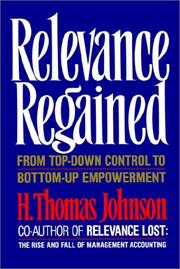
Relevance Regained
Johnson's follow-up, arguing against the ABC fix he helped start.
Summary
Thomas Johnson wrote this five years after Relevance Lost and reversed his own conclusion. Having argued with Robert Kaplan that management accounting needed better cost measurement, he now argues that the problem cannot be solved by accounting at all, and that activity-based costing, which followed from their earlier book, is a mistake.
His new position is that managing by financial results is the error, regardless of how accurate the results are. Accounting numbers are abstractions produced after the fact, and using them to direct operations means managers respond to consequences rather than to causes. He draws on the quality movement, particularly Deming, and on Toyota's practices, to argue that operations should be managed by observing and improving the processes themselves: reducing variation, removing waste, shortening cycle times and responding to customer demand directly. Financial results then follow.
He contrasts what he calls management by results with management by means, and argues that American companies adopted the first while the Japanese firms that outcompeted them used the second. The specific target is remote control management: executives directing organisations through financial targets communicated downward, without knowledge of the work. Johnson's argument has been influential in the lean accounting movement and overlaps with Maskell's practical work. Critics note that he does not explain how capital allocation decisions should be made without financial measures, and that the argument is stronger as a critique than as a system.
Key takeaways 7
- Managing by financial results directs attention to consequences rather than to the processes that produce them.
- Johnson repudiates activity-based costing, arguing that more accurate cost allocation does not address the underlying problem.
- Operations should be managed by observing and improving processes directly rather than by responding to accounting reports.
- Remote control management, in which executives direct organisations through financial targets, requires knowledge those executives do not have.
- Reducing variation and shortening cycle time improves financial results as a consequence, so targeting the results directly is unnecessary.
- Johnson argues that American firms adopted management by results while their Japanese competitors used management by means.
- Cost is an outcome of how work is organised, so it cannot be managed as an independent variable.
Who should read it
Executives sceptical of management by financial target who want the argument for process-based management from an accounting historian who changed his mind.
Where it sits in the reference 2
Similar books 6
Chosen by shared topics, the entries that hold them, and the people who recommended both.