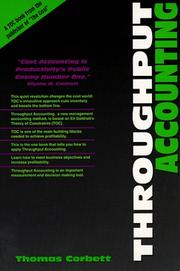
Throughput Accounting
Goldratt's constraint thinking turned into a costing method.
Summary
Thomas Corbett sets out the accounting approach derived from Eliyahu Goldratt's theory of constraints, and argues that conventional cost accounting produces decisions that damage the business.
The framework uses three measures. Throughput is the rate at which the system generates money through sales, calculated as revenue minus totally variable costs, which in most manufacturing means materials only. Inventory or investment is the money tied up in things the system intends to sell. Operating expense is all the money spent turning inventory into throughput, which includes labour and overhead, treated as period costs rather than allocated to products.
The key move is refusing to allocate labour and overhead to units. Corbett argues that this allocation, which conventional cost accounting requires, produces a product cost that is an artefact of the allocation base and that decisions made from it, including which products to discontinue, whether to accept a special order and whether to make or buy, are systematically wrong. Under throughput accounting the correct decision rule is to maximise throughput per unit of the constraint, since the constraint determines the system's output. He works through examples showing conventional and throughput analysis reaching opposite conclusions. The approach is genuinely clarifying for constrained manufacturing operations. Its limitation is that it assumes a single identifiable constraint and that operating expenses are fixed, neither of which holds over longer horizons or in businesses with substantial variable overhead.
Key takeaways 7
- Throughput is revenue minus totally variable costs, which in most manufacturing means materials alone.
- Labour and overhead should be treated as period expenses rather than allocated to products.
- Allocated product costs are artefacts of the allocation base, and decisions made from them are systematically wrong.
- The correct decision rule is to maximise throughput per unit of the system's constraint, since the constraint determines output.
- Local efficiency improvements at non-constraint resources produce inventory rather than output.
- Corbett works through examples where conventional and throughput analysis reach opposite conclusions about product profitability.
- The approach assumes a single identifiable constraint and fixed operating expenses, neither of which holds over longer horizons.
Who should read it
Manufacturing managers and controllers making product mix and capacity decisions who want a decision framework that does not rely on allocated costs.
Where it sits in the reference 2
Similar books 6
Chosen by shared topics, the entries that hold them, and the people who recommended both.