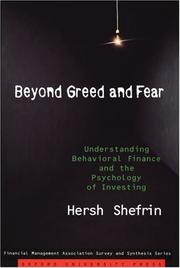
Beyond Greed and Fear
The academic bridge between behavioural finance and portfolio practice.
Summary
Shefrin, an academic who worked with Meir Statman on behavioural portfolio theory, wrote this to translate behavioural finance research into terms practitioners could use.
The organising framework has three themes. Heuristic-driven bias covers the mental shortcuts that produce systematic errors: representativeness, which causes investors to judge a company's stock by the company's quality; overconfidence in one's own information and judgement; anchoring on prior prices; and availability, which causes recent and vivid events to dominate assessment. Frame dependence covers the finding that the way a decision is presented changes the choice, including loss aversion, mental accounting that separates money into categories treated differently, and the disposition effect, meaning the tendency to sell winners and hold losers. Inefficient markets covers the resulting asset pricing consequences.
The applications are what distinguish the book. Shefrin applies the framework to individual investors, to professional money managers whose own biases affect their decisions, to analysts whose forecasts show predictable patterns of over-optimism and slow revision, to corporate managers making capital budgeting and acquisition decisions, to options markets, to the equity premium through myopic loss aversion, and to financial advisers managing clients.
His behavioural portfolio theory, developed with Statman, argues that investors construct portfolios as layers corresponding to separate goals rather than as a single optimised whole, which explains why people simultaneously hold insurance and lottery tickets and why they resist the mean-variance framework.
The book is from 2000 and the field has developed since. Some of the studies cited come from literatures affected by replication problems. The disposition effect, the analyst forecast patterns and the mental accounting findings have held up well. Shefrin writes clearly and the practitioner orientation makes it more usable than the academic collections.
Key takeaways 7
- Investors judge a stock by the quality of the company, which confuses a good business with a good investment.
- Investors sell winning positions and hold losing ones, which is documented directly in account data and is costly after tax.
- Analyst forecasts show predictable over-optimism and revise too slowly in response to new information.
- Investors construct portfolios as separate layers for separate goals rather than as a single optimised whole.
- Frequent portfolio evaluation combined with loss aversion explains the size of the equity premium.
- Professional money managers exhibit the same biases as individuals, and their institutional setting adds new ones.
- Corporate managers making acquisitions display overconfidence in their own ability to improve the target.
Who should read it
Practitioners in investment management and advice who want behavioural findings organised around the decisions they actually make.
Where it sits in the reference 2
Similar books 6
Chosen by shared topics, the entries that hold them, and the people who recommended both.