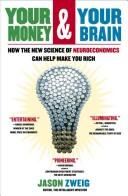
Your Money and Your Brain
Neuroscience of investing decisions, written by Graham's modern editor.
Summary
Zweig, a financial journalist, reports the neuroscience and psychology of investing decisions, drawing on interviews with researchers and on his own participation in imaging experiments. The chapters are organised around specific mental functions: greed, prediction, confidence, risk, fear, surprise, regret and happiness.
The findings he reports include: anticipating a gain activates the same reward circuitry as other appetitive stimuli and the anticipation produces more activation than the gain itself; the brain detects and responds to patterns in random sequences automatically, which is why investors see trends in noise; losses activate the amygdala and produce responses that persist after the situation has changed; the response to a monetary loss resembles the response to physical danger; and confidence in a judgement is generated by a process largely independent of the judgement's accuracy.
His practical recommendations follow: automate decisions so they are made in advance rather than in the presence of the stimulus, use written investment policies, deliberately reduce the frequency of portfolio checking because the more often you look the more losses you see, and construct the environment so that emotional responses do not reach the decision.
The neuroscience is from the 2000s and neuroeconomics as a field has produced less than its early promise suggested. Several of the imaging findings have been questioned on methodological grounds, particularly small sample sizes and analytical flexibility in fMRI research. The behavioural advice is sound and mostly derivable from psychology that does not depend on the brain imaging.
Key takeaways 7
- Anticipating a financial gain activates reward circuitry more strongly than receiving it, which is why the pursuit of returns is more compelling than the returns themselves.
- The brain detects patterns in random sequences automatically and involuntarily, which is why investors perceive trends in noise regardless of what they know.
- A monetary loss produces a physiological response resembling the response to physical threat, which is why loss-driven decisions are made before deliberation occurs.
- Checking a portfolio more frequently produces more observed losses, which increases the probability of a damaging reaction without adding information.
- Confidence in a judgement is generated by a process largely independent of that judgement's accuracy, which makes felt certainty uninformative.
- Decisions made in advance and automated are protected from the emotional responses that occur in the presence of price movement.
- Constructing the environment so that emotional triggers do not reach the decision works better than attempting to overcome the responses when they occur.
Who should read it
Investors who want the physiological account of why their own decisions go wrong and practical environmental changes to prevent it.
About Jason Zweig
Columnist, 'The Intelligent Investor', The Wall Street Journal; previously Money, Time and Forbes
Your Money and Your Brain brought neuroeconomics to a general investing audience, and his annotated edition of Benjamin Graham keeps a canonical text usable for modern readers.
Where it sits in the reference 3
Who recommended it 1 · 1 direct
Similar books 6
Chosen by shared topics, the entries that hold them, and the people who recommended both.