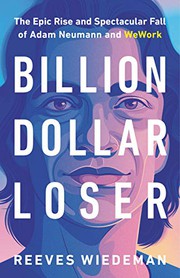
Billion Dollar Loser: The Epic Rise and Spectacular Fall of Adam Neumann and WeWork
Character-driven and closest to Neumann himself.
Summary
Wiedeman, a New York magazine reporter, wrote one of the two major accounts of WeWork's rise and failed public offering, based on interviews with several hundred current and former employees, investors and associates.
His emphasis differs from the Wall Street Journal account by Brown and Farrell. Wiedeman spends more time on Neumann personally and on the internal culture: the recruiting of young employees on a mission framing, the mandatory summer camp, the alcohol, the treatment of staff during layoffs, the personal spending, and the way Neumann's family occupied positions in the company. He documents Neumann's purchase of properties leased back to WeWork, the trademark payment for the word We, and the loans taken against his stock.
The business analysis is present but lighter. Wiedeman covers the core economics of long-term leases funding short-term subletting, the losses that grew with each new building, the failed expansions into schools and housing, and the valuation sequence driven by SoftBank.
The two books cover the same events and either serves. Wiedeman's is the better account of the culture and of Neumann as a person; Brown and Farrell's is the better account of the financing, the governance and the bankers. Neither seriously examines whether flexible office space is a viable business, which the sector's subsequent recovery under other operators makes a live question.
Key takeaways 7
- WeWork's unit economics worsened with each new building, because expansion added long-term lease obligations against revenue that took years to mature.
- Neumann extracted personal value through properties leased back to the company, a payment for the We trademark, and loans against his own stock.
- The company recruited young employees on a mission framing that substituted belief for compensation and made internal criticism feel like disloyalty.
- Expansion into schools, housing and other categories was pursued without any operating basis, and each initiative consumed capital and management attention.
- SoftBank's investments repeatedly rewarded the behaviour that made the company more fragile, and each round validated the previous valuation.
- Board members with financial interests in the company's continued fundraising did not exercise any restraining function.
- The mission language served a commercial purpose by supporting a technology valuation for a real estate business.
Who should read it
Founders and investors who want the cultural and personal account of the WeWork failure, complementary to the finance-focused Cult of We.
Where it sits in the reference 4
Similar books 6
Chosen by shared topics, the entries that hold them, and the people who recommended both.