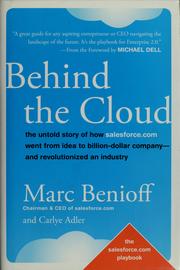
Behind the Cloud
Salesforce's founder on inventing the SaaS sales and pricing model.
Summary
Benioff documents how Salesforce was built from 1999, organised as one hundred and eleven numbered plays across nine sections covering the start-up, marketing, events, sales, technology, corporate philanthropy, global expansion, finance and leadership.
The marketing material is the most distinctive. Benioff created the end of software campaign, staged a protest with hired actors outside a Siebel Systems conference, and consistently positioned Salesforce against an enemy rather than describing its own features. His argument is that a new category needs a defined opponent to be comprehensible, and that generating press coverage costs far less than advertising and works better for a company nobody has heard of.
The business model content covers the subscription pricing decision, the choice to run one version of the software for all customers rather than customised installations, the free trial as the sales mechanism, and the land and expand approach of selling small deployments to individual departments rather than negotiating enterprise contracts. The philanthropy section describes the one-one-one model, committing one percent of equity, one percent of product and one percent of employee time from founding, which Benioff argues was a recruiting and retention advantage as well as a commitment.
The book is a founder's account of his own success and it reads as promotional. Failures receive little attention, including the early outages that damaged customer trust and the later acquisitions. The specific tactics are from 2000 to 2009 and the software as a service model Benioff was fighting for is now the default, which removes the context that made the positioning work. The category creation and enemy positioning material transfers best.
Key takeaways 8
- A new category becomes comprehensible by defining an enemy, and Salesforce positioned against installed enterprise software rather than describing its own features.
- Press coverage costs far less than advertising and works better for a company nobody has heard of, which makes stunts a rational marketing expenditure.
- Running a single version of the software for every customer removed the cost structure that made traditional enterprise software expensive to deliver.
- Selling small deployments to individual departments and expanding from there avoided the enterprise procurement process entirely.
- A free trial that lets the customer use the actual product replaces the demonstration and shortens the sales cycle.
- Subscription pricing aligned the company's revenue with continuing customer satisfaction rather than with a one-time purchase decision.
- Committing one percent of equity, product and employee time from founding was cheap at the time and became a substantial recruiting advantage.
- Events that gather customers create the community that makes an enterprise product difficult to displace.
Who should read it
Founders creating a new software category who want the marketing, pricing and land-and-expand tactics from the company that established the model.
About Marc Benioff
Co-founder, chairman and chief executive of Salesforce, which he started in 1999 after thirteen years at Oracle.
Behind the Cloud sets out the method Salesforce used to sell software as a subscription before that model was established - the V2MOM planning document, the 1-1-1 philanthropy structure, and the No Software positioning against on-premise incumbents. Operators building recurring-revenue businesses read it for the go-to-market sequence rather than for the memoir.
Where it sits in the reference 4
Who recommended it 6
Similar books 6
Chosen by shared topics, the entries that hold them, and the people who recommended both.