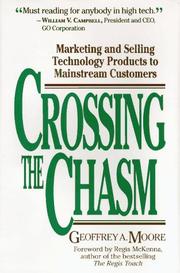
Crossing the Chasm
Why technology products stall between early adopters and the mainstream.
Summary
Moore takes the technology adoption life cycle, which divides buyers into innovators, early adopters, early majority, late majority and laggards, and argues that the standard bell curve conceals a gap. Early adopters buy a change agent and accept incomplete products. The early majority buys a productivity improvement and requires references from people like themselves. Since early adopters are not useful references for the early majority, the transition is a discontinuity rather than a slope, and most technology companies fail inside it.
His prescription is to attack a single narrowly defined beachhead segment, dominate it completely, and use it as the reference base for adjacent segments. He argues for the whole product concept, meaning everything the customer needs to get the promised result including services, integration, training and partners, not just the core technology. He also insists on explicit positioning against a named competitive alternative, because pragmatist buyers evaluate within categories.
The supporting material includes the D-Day analogy for concentrated market entry, a segmentation method based on scenarios of specific target customers, distribution channel selection matched to the buyer, and a pricing argument that pragmatists pay a premium for the market leader.
The book was written in 1991 about enterprise technology sold through direct sales, and revised editions have updated the examples without changing the model. Product-led growth, self-serve distribution and consumer software fit the framework poorly. The chasm concept has been criticised as unfalsifiable, since any failure can be labelled a failed crossing. The beachhead argument and the whole product concept remain the most used parts.
Key takeaways 8
- A gap separates early adopters from the early majority because the two groups buy for different reasons and the first cannot serve as a reference for the second.
- A company crossing that gap must target a single narrow segment and dominate it before expanding, rather than pursuing several markets at once.
- Pragmatist buyers require references from other pragmatists in their own industry, which is why early adopter logos do not generate mainstream sales.
- Customers buy a whole product, meaning everything required to achieve the promised result, and vendors who ship only the core technology fail with mainstream buyers.
- Positioning requires naming a competitive alternative explicitly, because pragmatists evaluate within an established category rather than judging novelty.
- Market leadership in a small segment produces pricing power and pulls in partners, so segment share matters more than absolute revenue at this stage.
- The sales approach that won early adopters, based on vision and customisation, actively repels the early majority.
- Companies inside the gap often show revenue growth from early adopters while their sales model has already stopped working.
Who should read it
Founders and go-to-market leaders selling technology to businesses, deciding which segment to concentrate on and what a complete offering has to include.
About Geoffrey A. Moore
American technology-marketing consultant and venture partner at Mohr Davidow Ventures who wrote Crossing the Chasm.
Crossing the Chasm identifies the gap between early adopters and the pragmatic majority and prescribes the beachhead answer: dominate one narrow segment with a complete product before widening. Inside the Tornado and Living on the Fault Line carry the model into hypergrowth and into managing businesses at different stages of maturity at once.
Where it sits in the reference 5
Who recommended it 16 · 2 direct
Similar books 6
Chosen by shared topics, the entries that hold them, and the people who recommended both.