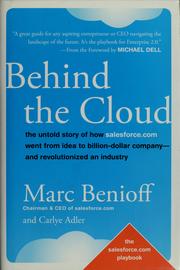
Behind the Cloud: The Untold Story of How Salesforce.com Went from Idea to Billion-Dollar Company
Summary
Benioff wrote this as an account of building Salesforce from 1999, organised as one hundred and eleven numbered plays grouped into sections on the startup, marketing, events, sales, technology, corporate philanthropy, global expansion, finance, leadership and management.
The substantive business content covers the subscription software model when it was new: selling a monthly per-user fee rather than a perpetual licence, which removed the customer's upfront risk and changed the vendor's revenue recognition and cash flow entirely; running a single multi-tenant instance rather than deploying software at each customer, which is what made the economics work; and the sales model built on rapid trial and low initial commitment.
The marketing material is the most distinctive. Benioff built the company's early awareness through positioning against Siebel and against enterprise software generally, staging protests outside competitors' conferences, and the End of Software campaign. His argument is that a small company must define the category and its own position in opposition to an incumbent, because the incumbent's marketing budget is otherwise decisive.
He also covers the one-one-one philanthropy model, in which one percent of equity, product and employee time was committed to a foundation at founding rather than later.
The book is a founder's account of a success and is promotional in tone. It presents no failures seriously. The plays are stated as rules without the conditions under which they apply. It is nonetheless a useful primary account of the subscription software transition by someone who executed it early.
Key takeaways 7
- Selling software as a monthly per-user subscription rather than a perpetual licence removed the customer's upfront risk and changed the vendor's cash flow entirely.
- Running a single multi-tenant instance rather than deploying software at each customer is what made the subscription economics work.
- A small company must define the category and position itself against an incumbent, because competing on marketing spend against an incumbent is not possible.
- Staging visible confrontation with a larger competitor generates coverage that a marketing budget cannot buy.
- Committing one percent of equity, product and employee time to a foundation at founding is far easier than adding philanthropy after the company is valuable.
- Free trials and low initial commitments convert the sales process from a purchase decision to a usage decision, which shortens the cycle enormously.
- Recurring revenue changes what the company must measure, since retention and expansion within existing accounts matter more than new bookings.
Who should read it
Founders building subscription software businesses who want a primary account of the model and of category-defining marketing.
About Marc Benioff
Co-founder, chairman and chief executive of Salesforce, which he started in 1999 after thirteen years at Oracle.
Behind the Cloud sets out the method Salesforce used to sell software as a subscription before that model was established - the V2MOM planning document, the 1-1-1 philanthropy structure, and the No Software positioning against on-premise incumbents. Operators building recurring-revenue businesses read it for the go-to-market sequence rather than for the memoir.
Where it sits in the reference 2
Who recommended it 1 · 1 direct
Similar books 6
Chosen by shared topics, the entries that hold them, and the people who recommended both.