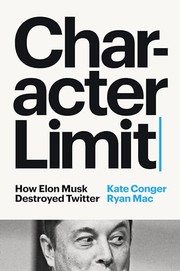
Breaking Twitter
Fast narrative of the takeover and the layoffs.
Summary
Mezrich reconstructs Elon Musk's acquisition of Twitter in 2022 and the months that followed, focusing on the internal experience of employees during the takeover, the mass layoffs and the reorganisation.
The narrative covers the stake accumulation and the offer, Musk's attempt to withdraw over the bot count dispute, the Delaware litigation that forced completion, the arrival at headquarters, the dismissal of the executive team, the cuts that removed roughly three quarters of staff, the ultimatum email requiring employees to commit to what Musk called hardcore work, the paid verification launch and its immediate abuse, the advertiser withdrawal, and the infrastructure decisions including the datacentre consolidation.
Mezrich writes narrative nonfiction with reconstructed dialogue, internal thoughts attributed to subjects, and scenes he did not witness. He has used this method since The Accidental Billionaires and it has drawn consistent criticism for the difficulty of separating what is documented from what is dramatised. Readers should treat specific scenes as unverified and the general sequence of events, which is well established from contemporaneous reporting, as reliable.
The book does not attempt business analysis. It says little about Twitter's pre-acquisition economics, which were poor, about why the advertising model underperformed relative to other social platforms, or about whether the cost reductions were justified by the revenue base. Anyone wanting to understand the transaction as a financial event, including the debt structure and its consequences, will need other sources. The account is also written from a moment when outcomes were unresolved.
Key takeaways 7
- Musk was contractually forced to complete an acquisition he attempted to abandon, because the merger agreement contained no financing or diligence outs.
- Roughly three quarters of Twitter's staff left or were dismissed within months without the service failing immediately.
- Paid verification launched without a mechanism to prevent impersonation, and the resulting abuse caused immediate advertiser damage.
- Advertisers withdrew primarily over brand safety and unpredictability rather than over any single policy decision.
- The acquisition debt was placed on the company itself, which turned an unprofitable business into one with large interest obligations.
- Institutional knowledge concentrated in small numbers of engineers was the binding constraint on how fast headcount could be cut.
- Reconstructed dialogue and attributed internal thoughts make this account unsuitable as a source for specific claims.
Who should read it
Readers wanting a narrative account of the takeover's internal experience, with the caveat that the method dramatises and the financial analysis is absent.
About Ben Mezrich
American author of dramatised nonfiction about card counting, Facebook's founding, the Winklevoss bitcoin position and the GameStop squeeze.
The books reconstruct financial episodes scene by scene from participant interviews, which is why several became films and why they reach readers who never open a market history. Read them as accounts told from one side, with dialogue and detail reconstructed rather than documented.
Where it sits in the reference 3
Similar books 6
Chosen by shared topics, the entries that hold them, and the people who recommended both.