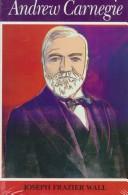
Carnegie
Harsher on the gap between Carnegie's preaching and his practice.
Summary
Krass wrote a long biography of Andrew Carnegie drawing on the Carnegie papers and on other archival material, covering the Scottish childhood, the Pennsylvania Railroad years, the bond selling, the entry into iron and steel, the construction and sale of Carnegie Steel, the Homestead strike and the philanthropy.
The business material covers the same ground as Joseph Frazier Wall's earlier standard biography: the cost accounting system that let Carnegie know his production cost at every stage, the counter-cyclical policy of building during depressions, the vertical integration into ore, coke and transport, the partnership structure with the ironclad agreement, and the willingness to scrap functioning equipment for better processes.
Krass is more critical than Wall on the personal and labour material. He is direct about Carnegie's evasions over Homestead, about the gap between his published views on labour and his conduct, about his treatment of partners and about the self-mythologising in Carnegie's own autobiography, which Krass shows to be unreliable on several points where documents survive.
The book is very long and Krass covers the personal life in detail, including the relationship with his mother and the late marriage. The reference has not verified all of its specific claims. Wall remains the scholarly standard and Krass is the more readable and more sceptical treatment. Either serves for the business material, which is where an investor's interest lies.
Key takeaways 7
- Carnegie's cost accounting, imported from railroad practice, told him his production cost at each stage when competitors did not know theirs.
- He expanded and rebuilt during depressions when construction was cheap and competitors were retrenching, taking share in every downturn.
- Scrapping functioning plant whenever a better process appeared reflected a correct treatment of sunk cost that competitors could not bring themselves to apply.
- Vertical integration into ore, coke and transport removed suppliers who could extract rents at the moment of highest demand.
- The ironclad partnership agreement allowed the firm to buy out partners at book value, which suppressed the value of their stakes until the 1901 sale.
- Carnegie's published views on labour were contradicted by his conduct at Homestead, which he managed by being absent and delegating the confrontation.
- Carnegie's own autobiography is unreliable on several points where documentary evidence survives, and Krass identifies where.
Who should read it
Investors and operators studying counter-cyclical investment and cost-based competition, in a more sceptical treatment than the standard biography.
Where it sits in the reference 2
Who recommended it 1 · 1 direct
Similar books 6
Chosen by shared topics, the entries that hold them, and the people who recommended both.