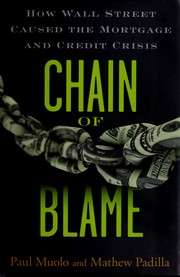
Chain of Blame: How Wall Street Caused the Mortgage and Credit Crisis
Closest coverage: Countrywide is a central thread in the trade-press account of the industry.
Summary
Muolo and Padilla, both trade journalists who had covered mortgage lending for years, wrote this account from inside the industry rather than from the financial markets end.
The distinguishing content is the originator history. They trace the subprime lending industry from its origins in the 1990s through the specific companies: Countrywide under Angelo Mozilo, Ameriquest under Roland Arnall, New Century, IndyMac, Long Beach, Option One and others. They document the business model at the origination level: commission-based loan officers paid on volume, yield spread premiums that paid brokers more for placing borrowers in higher-rate loans than they qualified for, stated income underwriting that required no verification, the progression from documented to reduced to no documentation, and the products including two-year adjustable rates that reset to unaffordable levels.
The chain of the title is the connection between these originators and Wall Street. Investment banks funded the originators through warehouse lines, bought their production, securitised it, and eventually acquired the originators outright in order to secure supply for their securitisation machines. Muolo and Padilla argue the demand ran downward: the securitisation desks needed loan volume, which drove the credit standards down at the origination end, rather than the originators pushing product upward.
The book was published in 2008, before the full consequences were known, and it is trade journalism rather than economic analysis. Its value is that the authors knew the mortgage industry's participants for years before the crisis and can describe how the origination business actually worked, which the accounts written from the securities end cannot.
Key takeaways 7
- Securitisation demand from investment banks drove credit standards down at the origination end rather than the reverse.
- Yield spread premiums paid brokers more for placing borrowers in higher-rate loans than the borrower qualified for.
- Loan officers and brokers were paid on volume with no exposure to whether the loan performed.
- Documentation standards progressed from full to reduced to none, and stated income loans required no verification at all.
- Investment banks acquired mortgage originators outright to secure loan supply for their securitisation operations.
- Warehouse lending from investment banks funded the originators, so the banks were exposed before the loans were even securitised.
- Adjustable rate products were underwritten at the initial rate rather than at the rate the borrower would face after reset.
Who should read it
Investors and lenders who want the origination-level account of subprime lending from journalists who covered the industry before it collapsed.
Where it sits in the reference 2
Similar books 6
Chosen by shared topics, the entries that hold them, and the people who recommended both.