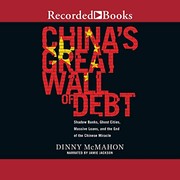
China's Great Wall of Debt
Local-government financing vehicles, shadow banking and the property build-out.
Summary
McMahon reported on Chinese finance for the Wall Street Journal from Beijing for a decade and wrote this account of the debt built up after 2008.
The mechanism is the substance. The 2008 stimulus directed enormous lending through the banking system, largely to local governments for infrastructure. Local governments were legally restricted from borrowing directly, so they created financing vehicles that borrowed against land as collateral, and the land's value depended on continued property price growth, which the same investment was helping to produce. McMahon traces this circularity through specific cities and projects, including the developments built where demand did not exist.
He explains the shadow banking system that grew when formal bank lending was restricted: wealth management products sold to depositors at higher rates than deposits, invested in assets the depositors could not see, with an implicit expectation of bank support that was never contractual; trust companies; and interbank arrangements that moved loans off bank balance sheets while the credit risk remained.
On non-performing loans he argues that the reported figures understate the problem substantially, because loans are rolled over rather than recognised, because bad assets are transferred to asset management companies at book value, and because the definition of non-performing is applied loosely.
He also covers the steel and coal overcapacity, the zombie enterprises kept operating because closure would produce unemployment, and the demographic pressure that limits how long growth can outrun the debt.
The book was published in 2018. The subsequent property developer defaults, beginning with Evergrande in 2021, and the local government financing vehicle pressures since have followed the mechanisms he describes. His prediction of an acute crisis has not occurred, which reflects the state's capacity to prevent recognition of losses in a closed capital account system.
Key takeaways 7
- Local governments borrowed through financing vehicles against land collateral whose value depended on the property growth their own investment produced.
- Wealth management products sold to depositors carried an implicit expectation of bank support that was never contractual.
- Shadow banking grew specifically in response to restrictions on formal bank lending, so regulation redirected rather than reduced credit.
- Reported non-performing loan figures understate the problem because loans are rolled over rather than recognised.
- Transferring bad assets to asset management companies at book value defers recognition rather than resolving the loss.
- Zombie enterprises in steel and coal are kept operating because closure would produce unemployment the state will not accept.
- A closed capital account lets the state prevent recognition of losses for far longer than an open financial system would permit.
Who should read it
Investors with China exposure who need the mechanics of local government debt, shadow banking and loan recognition.
Where it sits in the reference 2
Similar books 6
Chosen by shared topics, the entries that hold them, and the people who recommended both.