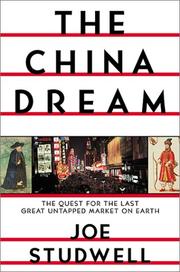
The China Dream
The recurring foreign delusion about the size of the China opportunity.
Summary
Studwell, a business journalist who edited the China Economic Quarterly, wrote this in 2002 as an attack on the assumptions underlying foreign investment in China during the 1990s.
The historical argument frames the period as the latest instance of a recurring pattern. Foreign businesses have repeatedly convinced themselves that the size of China's population implies a proportional market, and have invested on that basis. Studwell traces earlier episodes, including the nineteenth-century treaty port era and the 1930s, and shows that the returns disappointed each time.
The contemporary analysis covers the 1990s investment wave. He documents the joint venture requirement, which forced foreign firms to share technology and profits with partners selected by the state; the fact that most multinational operations in China were losing money while reporting strategic progress; the gap between announced investment and deployed capital; the role of Hong Kong round-tripping in the foreign investment statistics; the state-owned enterprise sector's losses and the banking system's non-performing loans; and the political system's unwillingness to permit the market outcomes that would resolve these.
Studwell's forecast was that the disappointment would become visible and that the banking system's bad debts would force a reckoning.
The forecast was wrong in the way that matters. China's growth continued for two more decades and many foreign firms eventually made substantial returns, particularly in automotive and consumer goods. The banking system's non-performing loans were resolved through recapitalisation and growth rather than through crisis. Studwell's later book, How Asia Works, is the better statement of his analysis. This one remains useful as a corrective to extrapolating market size from population, and its documentation of the joint venture terms and of the gap between announcements and reality is accurate for its period.
Key takeaways 7
- Foreign firms have repeatedly inferred market size from population and have repeatedly been disappointed.
- Joint venture requirements forced foreign firms to transfer technology and share profits with state-selected partners.
- Most multinational operations in China during the 1990s were losing money while reporting strategic progress to their boards.
- Announced foreign investment figures substantially exceeded capital actually deployed.
- A significant share of reported foreign direct investment was domestic capital routed through Hong Kong for tax and legal treatment.
- State-owned enterprise losses and the resulting bank non-performing loans were far larger than official figures indicated.
- The book's prediction of a reckoning was wrong, which is itself evidence about the limits of this analysis.
Who should read it
Investors entering large emerging markets who want a documented corrective to inferring opportunity from population size, read knowing the forecast failed.
About Joe Studwell
Journalist and author on East Asian business and development; founding editor of the China Economic Quarterly.
How Asia Works argues that Japan, Korea, Taiwan and China grew by sequencing three policies - household-scale land reform, export discipline imposed on manufacturers, and finance directed to both - and explains why Southeast Asian states that skipped the sequence stalled. Asian Godfathers documents how the region's tycoon conglomerates earn returns from licences, property and cheap deposits rather than from operating skill.
Where it sits in the reference 3
Similar books 6
Chosen by shared topics, the entries that hold them, and the people who recommended both.