Confessions of the Pricing Man
Simon-Kucher's founder on price as the main profit lever.
Summary
Simon founded Simon-Kucher, the pricing consultancy, and this book combines his career account with the practical content of pricing strategy. His central claim is that price is the most powerful profit lever available to a company and the one that receives the least management attention.
The arithmetic is his opening argument: for a typical company, a one percent price improvement produces a larger profit increase than a one percent volume increase or a one percent cost reduction, because price flows directly to the bottom line while volume brings variable cost with it. From this he argues that pricing deserves chief executive attention and a dedicated organisational function.
The practical material covers value-based pricing, price differentiation across customer segments, non-linear pricing including two-part tariffs and bundles, the psychology of price perception including anchoring and reference prices, pricing in downturns where he argues volume should be sacrificed before price, and the strategic choice between premium, low-price and luxury positions, each of which he treats as internally coherent while the middle is not.
He uses cases from his consulting practice, including work with industrial and consumer companies across Europe and Asia, and he is candid about pricing failures. He also gives extended treatment to the German Mittelstand and to why price wars start and how to avoid entering one.
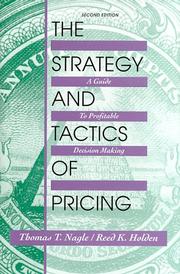
The book is anecdotal where Nagle and Holden is systematic, and readers wanting a method should use both. Simon's claims about the effect of his own firm's engagements are not independently verifiable.
Key takeaways 7
- A one percent price improvement raises profit more than a one percent volume increase or cost reduction, because price change flows directly to profit without variable cost.
- Pricing receives less management attention than cost or volume despite having the largest effect on profit, which is the single largest available improvement in most companies.
- Price should be derived from the customer's perceived value, and the practical task is measuring that value rather than assuming it.
- In a downturn a company should sacrifice volume before price, because price reductions are difficult to reverse and reset the customer's reference point permanently.
- Premium, low-price and luxury positions are each internally coherent strategies, while the middle position combines the costs of one with the pricing power of neither.
- Price wars are almost always started deliberately by a participant seeking share and almost never produce it, because competitors match immediately.
- Non-linear pricing structures, including two-part tariffs and bundles, capture more value than any single price can from a heterogeneous customer base.
Who should read it
Founders and executives who want a practitioner's account of pricing as the primary profit lever, with cases from industrial and consumer businesses.
Where it sits in the reference 3
Who recommended it 1
Similar books 6
Chosen by shared topics, the entries that hold them, and the people who recommended both.