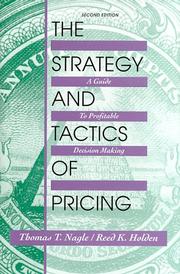
The Strategy and Tactics of Pricing
The standard text on value-based pricing.
Summary
Nagle and Holden wrote the standard practitioner textbook on pricing, now in multiple editions. Its central instruction is that price should be set from customer value rather than from cost or from competitors' prices, and it works out what that requires in practice.
The method starts with economic value estimation: identify the customer's next best alternative, calculate its price, then quantify the differentiation value of your offering relative to it in monetary terms. That produces a ceiling. The book then covers price structure, meaning how to charge rather than how much, including metrics, tiers, bundling and two-part tariffs; price and value communication, since differentiation value must be perceived to be paid for; pricing policy, which governs discounting and negotiation behaviour over time; and price level.
The strategic chapters cover segmented pricing, competitive response and when not to respond to a competitor's price cut, the analysis of whether a price change is profitable given the required volume change at the relevant contribution margin, and price wars. The breakeven sales change analysis is the most immediately usable tool: it shows how much additional volume a price cut requires to be worthwhile, and the answer is almost always more than managers assume.
The book is a textbook, dry and thorough, and it assumes an industrial or business-to-business context more readily than a consumer subscription one. Later editions add software and subscription material but the framework predates modern usage-based and platform pricing. It remains the most complete treatment of the fundamentals.
Key takeaways 7
- Price should be set from the customer's economic value relative to their next best alternative, not from cost or from competitors' prices.
- Economic value equals the reference price of the customer's best alternative plus the monetary value of the differentiation, and both parts must be quantified.
- A price cut requires far more additional volume to be profitable than managers assume, and the required amount is determined by contribution margin.
- How you charge, meaning the pricing metric and structure, frequently matters more to profitability than how much you charge.
- Differentiation value must be communicated and believed before a customer will pay for it, so value communication is part of pricing rather than of marketing.
- Responding to a competitor's price cut is usually the wrong move, and the decision should turn on whether the competitor can sustain it and whether the cut is visible to your customers.
- Discounting policy should be set as a rule in advance, because discounts negotiated case by case teach customers to negotiate.
Who should read it
Operators and founders setting prices who need a complete method for value-based pricing, structure and discount policy.
Where it sits in the reference 5
Similar books 6
Chosen by shared topics, the entries that hold them, and the people who recommended both.