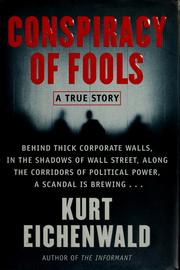
Conspiracy of Fools: A True Story
Narrative reconstruction from thousands of interviews.
Summary
Eichenwald reconstructs the Enron collapse as a narrative built from depositions, internal documents, emails and hundreds of interviews, written in scene-by-scene form with reconstructed dialogue. It covers the period from the mid-1990s through the bankruptcy and the criminal cases.
The account differs from the standard morality-tale version in one important respect. Eichenwald argues that the central failure was not a conspiracy of masterminds but a collapse of competence and attention across every layer that was supposed to provide a check: a board that approved conflict-of-interest waivers without understanding them, auditors at Arthur Andersen whose consulting revenue exceeded their audit fee, lawyers who signed off on structures they had not tested, banks that designed the financings and then sold Enron paper, and a chief executive in Ken Lay who did not follow what his own company did. Andrew Fastow emerges as the primary actor of self-enrichment through the LJM partnerships, while Jeff Skilling is portrayed as building a culture that made the accounting inevitable.
The technical material on mark-to-market accounting for long-dated energy contracts and on special purpose entities is explained clearly enough for a non-specialist, which is the book's main use to investors: it shows exactly how earnings can be recognised today for contracts that will never produce the assumed cash. The reconstructed-dialogue method has been criticised, since Eichenwald renders conversations he did not witness as direct speech, and readers who want the analytical version should read The Smartest Guys in the Room alongside it.
Key takeaways 7
- Enron's core accounting device was mark-to-market recognition of the full projected profit on long-dated contracts, which booked earnings that no cash ever validated.
- The special purpose entities were used to move debt off the balance sheet and to create counterparties that would take losses Enron did not want to report.
- Andrew Fastow's LJM partnerships enriched him personally at the company's expense, and the board explicitly waived the conflict of interest policy to permit them.
- Every external gatekeeper failed at once, and each failed because its fee income depended on the client rather than on the accuracy of its opinion.
- Ken Lay did not understand the transactions his company was executing, which made him useless as a check rather than a co-conspirator.
- Enron's performance review system, which forcibly ranked and fired the bottom tier each cycle, produced the reporting behaviour that made the fraud possible.
- Analysts and rating agencies continued to endorse the company after its filings had stopped being interpretable, because none of them wanted to be the one to break the position.
Who should read it
Investors and directors who want a detailed account of how accounting choices, incentive structures and gatekeeper conflicts combine into a corporate failure.
Where it sits in the reference 4
Who recommended it 1 · 1 direct
Similar books 6
Chosen by shared topics, the entries that hold them, and the people who recommended both.