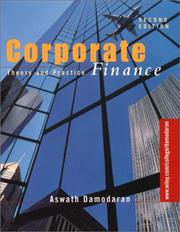
Corporate Finance: Theory and Practice
Open Library lists the title as "Corporate finance".
Summary
Damodaran wrote this as a full corporate finance textbook, more comprehensive and more technical than his Applied Corporate Finance.
The organisation follows the same three decisions: investment, financing and dividend policy, each assessed against the objective of maximising firm value. The treatment is fuller than the shorter book: more coverage of the theory, of the empirical evidence and of the special cases.
The investment section covers the estimation of hurdle rates in detail, including the problems in estimating beta for private firms, for firms with changing business mix and for emerging market companies; the measurement of returns using cash flows and the treatment of side effects, options and risk; and capital budgeting under uncertainty.
The financing section covers capital structure theory from Modigliani and Miller through the trade-off and pecking order theories, the empirical evidence on how firms actually choose, the determination of an optimal debt ratio using cost of capital minimisation and using adjusted present value, the mechanics of moving toward a target, and the design of debt to match asset characteristics including duration, currency and cyclicality.
The dividend section covers the theory and evidence on payout, the choice between dividends and repurchases, the signalling and clientele effects, and a framework for assessing whether a firm's payout is appropriate given its investment opportunities and its cash generation.
The later material covers valuation, acquisitions and value enhancement.
The book teaches the standard framework and applies it to real companies throughout, which is Damodaran's practice. It is a textbook rather than an argument, and its usefulness depends on whether the reader needs the fuller technical treatment or the shorter applied one. Damodaran maintains public datasets and spreadsheets that accompany the material and are updated continuously.
Key takeaways 7
- Every corporate finance decision reduces to investing, financing or returning cash, judged against the objective of maximising firm value.
- Beta estimation fails for private firms, for firms with changing business mix and for emerging market companies, which requires alternative approaches.
- Debt should be designed to match the characteristics of the assets it finances, including duration, currency and cyclicality.
- The optimal debt ratio can be estimated by minimising cost of capital or by adjusted present value, and the two give different answers.
- Firms in practice follow a pecking order using internal funds first, then debt, then equity, which the trade-off theory does not predict.
- Payout policy should be assessed against the firm's investment opportunities and its cash generation rather than against industry convention.
- Repurchases and dividends are not equivalent, because they differ in tax treatment, in signalling content and in flexibility.
Who should read it
Students and practitioners who need the full technical treatment of corporate finance rather than the applied summary.
About Aswath Damodaran
Kerschner Family Chair Professor of Finance, NYU Stern School of Business
His valuation textbooks and freely published datasets are the default reference used across academia, banking and investing.
Where it sits in the reference 2
Similar books 6
Chosen by shared topics, the entries that hold them, and the people who recommended both.