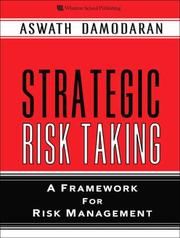
Strategic Risk Taking: A Framework for Risk Management
Summary
Aswath Damodaran argues that risk management as usually practised concentrates on reducing exposure and ignores the fact that firms create value by taking risks they are equipped to take. His framework attempts to connect risk measurement, valuation and strategy.
The book begins with the history and measurement of risk: probability, the development of risk measures in finance, the capital asset pricing model and its alternatives, and the behavioural evidence on how people actually assess risk. It then covers the tools for handling risk in valuation, including scenario analysis, decision trees, simulation and value at risk, and Damodaran is careful about what each can and cannot do. He argues that risk-adjusted discount rates and explicit probability modelling are alternatives rather than complements, and that using both double-counts.
The strategic section is the distinctive part. Damodaran argues that a firm's risk-taking should be concentrated where it has a comparative advantage in bearing risk, which can come from better information, from a stronger balance sheet, from operating flexibility or from speed of response. He treats real options as a way of valuing that flexibility while being sceptical about their casual application, and he insists that an option has value only when there is genuine exclusivity and genuine learning between now and the decision. The book is long and reads as a textbook. Its argument that risk management should increase deliberate risk-taking in the right places is the reason to read it.
Key takeaways 7
- Firms create value by taking risks they are equipped to bear, so risk management that only reduces exposure destroys value.
- Risk-adjusted discount rates and explicit probability modelling are alternatives, and using both double-counts the same risk.
- A firm's comparative advantage in bearing a risk can come from information, balance sheet strength, flexibility or speed of response.
- Real options have value only where there is genuine exclusivity and genuine learning before the decision must be made.
- Simulation and decision trees produce distributions of value rather than point estimates, which changes what the analyst can say.
- Value at risk answers a narrow question about a threshold and says nothing about the size of losses beyond it.
- Damodaran argues that hedging a risk the firm is paid to bear transfers away the source of its returns.
Who should read it
Investors and corporate finance practitioners who want risk treated as a strategic variable connected to valuation rather than as an exposure to be minimised.
About Aswath Damodaran
Kerschner Family Chair Professor of Finance, NYU Stern School of Business
His valuation textbooks and freely published datasets are the default reference used across academia, banking and investing.
Where it sits in the reference 2
Similar books 6
Chosen by shared topics, the entries that hold them, and the people who recommended both.