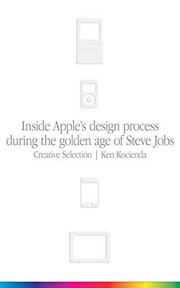
Creative Selection
Insider account by the engineer who built the iPhone keyboard.
Summary
Kocienda was a software engineer at Apple from 2001 to 2017 and worked on Safari, on the iPhone keyboard and on the iPad. He documents how software was actually developed there, which he presents as a specific process rather than as a culture.
The process he calls creative selection consists of building a demo, showing it to a small group, receiving a decision, and iterating. He describes the demo as the unit of work: everything was decided by looking at something running rather than by discussing a specification or a document. Demos were shown up a chain that ended with Jobs, and the decisions were made in the room by one person.
His account of the iPhone keyboard development is the book's centre. The team faced the problem that a touchscreen keyboard had no tactile feedback and that fingers were larger than the keys. He describes the internal competition in which several engineers each built a candidate, the selection of his approach, and the subsequent work on the autocorrection algorithm and the dictionary that made it usable.
The seven elements he identifies as the culture's basis are inspiration, collaboration, craft, diligence, decisiveness, taste and empathy, and he defines each with examples rather than as values. The book is a personal account and does not address Apple's failures, its labour practices or the periods when the process did not work. It is narrow by design, covering software development rather than the company. The demo-driven decision process and the account of the keyboard problem are the substantive material.
Key takeaways 8
- Decisions were made by looking at something running rather than by discussing a specification or a document.
- A demo is the unit of work, which means the question at every stage is what can be shown rather than what can be described.
- Demos were shown to a small group and a single person made the decision in the room rather than through a process.
- Internal competition in which several engineers each built a candidate produced the iPhone keyboard, and the selection was made by comparing working versions.
- Autocorrection rather than key size solved the touchscreen keyboard problem, which required accepting that users would hit the wrong keys.
- Concrete demonstration removes the ambiguity that verbal descriptions of software preserve, which is why the process moved faster than specification-driven development.
- The seven elements Kocienda identifies are defined by examples of behaviour rather than as values to be stated.
- The account covers software development rather than the company, and does not address Apple's failures or its labour practices.
Who should read it
Product and engineering leaders who want a concrete account of a demo-driven decision process from inside a company that used it.
Where it sits in the reference 2
Who recommended it 3
Similar books 6
Chosen by shared topics, the entries that hold them, and the people who recommended both.