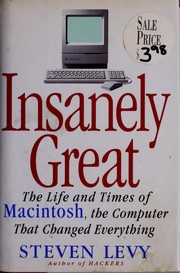
Insanely Great
The making of the Macintosh, written close to the events.
Summary
Steven Levy wrote this account of the Macintosh a decade after its 1984 launch, drawing on interviews with the development team and on his own reporting for Rolling Stone and Popular Computing at the time. He traces the graphical interface from Douglas Engelbart's work at SRI in the 1960s through Xerox PARC's Alto to the Lisa and then the Macintosh.
Levy's argument is that the Macintosh mattered because it made a set of interface ideas cheap enough to reach ordinary users, and that this required specific engineering decisions and specific personalities. He covers Jef Raskin's original conception of an appliance computer and his displacement by Steve Jobs, the bitmapped display, the mouse, the decision to include no expansion slots, the 128 kilobyte memory constraint that crippled the first machine, and the culture of the development team. He is direct about the failures, including the machine's commercial disappointment in 1984 and 1985 and the internal conflict that followed.
The book stops in the early 1990s, when Apple was declining and the Macintosh's interface ideas had been absorbed by Windows. Levy's assessment of Apple's prospects has been overtaken, and the book contains none of the story that made Apple the most valuable company in the world. Its value is the detailed record of a specific product development and of the argument, then unresolved, about whether interface quality could be a durable competitive advantage.
Key takeaways 7
- The graphical interface originated at Engelbart's laboratory and at Xerox PARC, and Apple's contribution was making it affordable rather than inventing it.
- Jobs's insistence on a closed machine without expansion slots reflected a product philosophy that customers initially rejected.
- The original Macintosh shipped with too little memory to run the software its interface required, which nearly killed it.
- Levy argues that interface design is an engineering discipline with correct and incorrect answers, not a matter of taste.
- The Macintosh development team's isolation from the rest of Apple produced both the product's coherence and the organisation's later dysfunction.
- Desktop publishing, driven by the LaserWriter and PageMaker, saved the Macintosh by supplying a use case the interface uniquely enabled.
- Apple failed to convert its interface lead into a durable position because it declined to license the software separately from the hardware.
Who should read it
Founders and product leaders who want a detailed record of how a category-defining product was designed, mismanaged and rescued by an unplanned application.
About Steven Levy
American technology journalist and editor at large at Wired who wrote histories of hacker culture, Apple, Google and Facebook.
Hackers documented the MIT and Homebrew programming culture of the 1950s through the 1980s and named the ethic that later shaped open source and startup engineering. In the Plex and Facebook report from inside those companies on how their products, ranking systems and business models were actually built.
Where it sits in the reference 2
Similar books 6
Chosen by shared topics, the entries that hold them, and the people who recommended both.