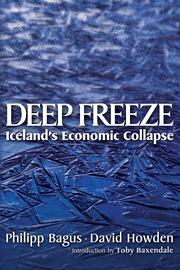
Deep Freeze
Austrian-school reading of the credit boom and currency mismatch.
Summary
Bagus and Howden, both economists working in the Austrian tradition, wrote an analysis of the Icelandic banking collapse from that theoretical perspective.
Their account applies Austrian business cycle theory to the case. Credit expansion not backed by real saving distorts the structure of production by making long-duration investments appear profitable at artificially low interest rates. In Iceland the expansion was funded externally rather than domestically: the banks borrowed short-term in foreign wholesale markets and lent long-term, which they treat as a maturity mismatch that is the defining feature of fractional reserve banking and the source of its instability.
They add a currency dimension. The banks' liabilities were in foreign currency while a central bank can only supply its own, which meant no lender of last resort existed for the actual exposure. They argue this makes the Icelandic case a clean demonstration that maturity mismatch rather than any particular asset choice is what destroys banks.
The policy analysis attacks the deposit insurance and implicit guarantee arrangements, arguing that they permitted risk-taking depositors would otherwise have restrained, and attacks the European Economic Area framework that let Icelandic banks take deposits across Europe while home supervision remained with a regulator that could not possibly support them.
Their prescription is full reserve banking, meaning that demand deposits should be backed one for one and that maturity transformation should be confined to instruments where holders accept the risk explicitly.
The Austrian framework is heterodox and its central claims are not accepted by most economists. The specific observation, that a banking system with foreign currency liabilities has no lender of last resort, is correct and is accepted independently of the theory. Johnsen's account, also in this reference, covers the same collapse from the investigation record without the theoretical commitment.
Key takeaways 7
- Icelandic banks borrowed short-term in foreign wholesale markets and lent long-term, which is a maturity mismatch in a foreign currency.
- A central bank can only supply its own currency, so no lender of last resort existed for foreign currency liabilities.
- Credit expansion not backed by real saving makes long-duration investments appear profitable at artificially low rates.
- Deposit insurance and implicit guarantees permitted risk-taking that depositors would otherwise have restrained.
- European rules let Icelandic banks take deposits across the continent while supervision remained with a regulator that could not support them.
- Maturity mismatch rather than any particular asset choice is what makes fractional reserve banking unstable in this account.
- The Austrian framework applied here is heterodox, though the foreign currency lender of last resort point is accepted independently of it.
Who should read it
Readers who want the Austrian analysis of a banking collapse, and anyone interested in the foreign currency liability problem for small open economies.
Where it sits in the reference 2
Similar books 6
Chosen by shared topics, the entries that hold them, and the people who recommended both.