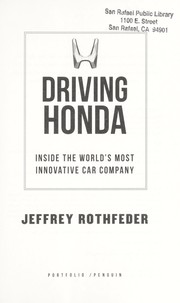
Driving Honda
The best modern account of Honda's decentralized engineering culture.
Summary
Rothfeder, a journalist, examines Honda's management philosophy and argues that it differs fundamentally from Toyota's and is less understood, despite Honda having entered markets from nothing repeatedly and succeeded.
The operating principles he identifies include: the three joys, meaning the joy of buying, selling and creating, which orders the company's priorities; genchi genbutsu, or going to the actual place, which Honda applies more literally than Toyota, requiring engineers to observe customers directly rather than work from research; the waigaya, an unstructured meeting in which rank is suspended and anyone may challenge anything, held until a conclusion is reached; and a deliberate policy of building where the products are sold, which Honda applied by manufacturing in Ohio long before other Japanese manufacturers did.
His central argument is that Honda's system is built around individual initiative and disagreement rather than around standardised process. Where Toyota's system produces consistency through standardisation, Honda's produces adaptation through argument and through engineers who own their projects. He cites the development of the Odyssey, the Ridgeline and the entry into aviation with HondaJet as products of this approach.
The book is admiring and Rothfeder had company access. It is thin on Honda's failures and on the periods when the approach produced poor results. The reference has not verified the specific claims about internal processes. Its value is presenting a coherent alternative to the Toyota model that most operations literature treats as the only Japanese system.
Key takeaways 7
- Honda's system produces adaptation through individual initiative and structured disagreement, where Toyota's produces consistency through standardisation.
- The waigaya meeting suspends rank entirely and continues until a conclusion is reached, which surfaces objections that hierarchy would suppress.
- Engineers are required to observe customers and conditions directly rather than work from market research, which produces product decisions research would not support.
- Building products in the markets where they are sold was adopted early and deliberately, before other Japanese manufacturers did it.
- Honda entered markets from nothing repeatedly, including motorcycles, cars, engines and aviation, which suggests the method is transferable rather than product-specific.
- Individual engineers own their projects and are expected to argue for them, which makes personal conviction part of the development process.
- The reference has not verified the specific claims about Honda's internal processes in this account.
Who should read it
Operators who want an alternative to the Toyota model, built on individual initiative and disagreement rather than standardisation.
Where it sits in the reference 2
Who recommended it 1 · 1 direct
Similar books 6
Chosen by shared topics, the entries that hold them, and the people who recommended both.