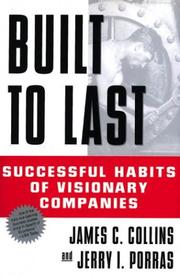
Built to Last
Open Library unreachable this run; title not machine-verified.
Summary
Collins and Porras studied eighteen companies founded before 1950 that had outperformed the market over decades, each matched against a comparison company in the same industry founded around the same time. The pairs include Hewlett-Packard against Texas Instruments, Procter and Gamble against Colgate, Boeing against McDonnell Douglas, and Merck against Pfizer.
The central finding is what they call preserving the core and stimulating progress. Enduring companies hold a fixed core ideology, consisting of core values and a purpose beyond profit, while changing everything else including strategy, structure and practices continuously. They argue that the ideology's content matters less than its consistency and the extent to which it is actually enforced.
Other findings include the argument that these companies were built as clock builders rather than time tellers, meaning the founders built organisations rather than relied on personal charisma or a single great idea; big hairy audacious goals, meaning commitments so large they force the organisation to change; cult-like cultures with tight selection and indoctrination; trying a lot of things and keeping what works, which they document at 3M and Johnson and Johnson; home-grown management, with almost all chief executives promoted internally; and the rejection of what they call the tyranny of the or in favour of holding apparently contradictory objectives simultaneously.
The methodological problem is the same as in Good to Great. Selecting on outcomes cannot show whether unsuccessful companies shared the same traits. Rosenzweig's Halo Effect argues that the cultural descriptions were shaped by known results. Several of the visionary companies subsequently declined sharply, including Motorola, Sony, Ford and Hewlett-Packard, which the framework does not explain. The core ideology and clock building arguments remain widely used.
Key takeaways 8
- Enduring companies preserve a fixed core ideology while changing strategies, structures and practices continuously.
- The specific content of a core ideology matters less than whether it is consistently held and actually enforced in decisions.
- Founders of these companies built organisations rather than relied on a single great product idea or on personal charisma.
- Goals large enough to force organisational change produce more progress than incremental targets, and the companies studied set them repeatedly.
- These companies selected and indoctrinated employees tightly, and people who did not fit left quickly, which the authors present as a strength.
- Trying many things and keeping what works produced several of the most important products, which arrived through experimentation rather than through planning.
- Almost all chief executives at these companies were promoted internally, which preserved the ideology across generations.
- Holding apparently contradictory objectives simultaneously, rather than choosing between them, characterised these companies across many decisions.
Who should read it
Founders and executives thinking about institutional durability, who should treat the findings as hypotheses given the selection problem.
About Jim Collins
Management researcher; Stanford Graduate School of Business faculty 1988-1995, since then an independent researcher running a management laboratory in Boulder, Colorado
Built to Last and Good to Great are the primary research sources the enduring-company literature builds on and argues with.
Where it sits in the reference 3
Who recommended it 6 · 1 direct
Similar books 6
Chosen by shared topics, the entries that hold them, and the people who recommended both.