Great by Choice
Open Library unreachable this run; title not machine-verified.
Summary
Collins and Hansen study companies that performed exceptionally in turbulent environments, selecting firms that beat their industry index by at least ten times over fifteen years in industries with high volatility. The seven they call 10X companies include Southwest Airlines, Intel, Microsoft, Amgen, Progressive Insurance, Stryker and Biomet, each matched against a comparison company. The findings are counterintuitive relative to the usual narrative about turbulent markets. The 10X leaders were not more risk-taking, more visionary or more creative than the comparisons. They were more disciplined, more empirical and more paranoid.
The three behaviours are fanatical discipline, meaning consistency of action over long periods regardless of conditions; empirical creativity, meaning that decisions were based on direct evidence rather than on conventional wisdom or on the opinions of others; and productive paranoia, meaning maintaining reserves and margins of safety far beyond what conditions appeared to require.
Their specific concepts include the twenty mile march, meaning a consistent performance target hit every year in both good and bad conditions, with the discipline to not exceed it in good years; fire bullets then cannonballs, meaning small low-cost tests before large commitments and calibrating the large commitment on empirical validation; and the return on luck concept, in which the study found that 10X companies did not receive more good luck than comparisons but obtained higher returns from the luck they received.
The methodology is the same as Collins' earlier books and carries the same selection problem. The twenty mile march and the bullets and cannonballs sequence are the most usable ideas.
Key takeaways 8
- Companies that outperformed in turbulent environments were more disciplined and more empirical than their comparisons rather than more visionary or more risk-taking.
- A consistent performance target hit every year in both good and bad conditions outperforms a strategy that maximises in good years.
- The discipline to not exceed the target in good years is as important as hitting it in bad ones, because overreaching creates the exposure that the bad years exploit.
- Small low-cost tests should precede large commitments, and the large commitment should be calibrated on the empirical result rather than on conviction.
- Maintaining reserves and margins far beyond what conditions appear to require is what allows a company to survive events nobody predicted.
- Decisions were based on direct empirical evidence rather than on conventional wisdom, expert opinion or the actions of competitors.
- The successful companies did not receive more good luck than their comparisons, and obtained higher returns from the luck they received.
- The study selects on outcomes, which means it cannot show whether unsuccessful companies exhibited the same behaviours.
Who should read it
Executives operating in volatile industries who want a disciplined alternative to the usual advice about agility and risk-taking, with the selection problem understood.
About Jim Collins
Management researcher; Stanford Graduate School of Business faculty 1988-1995, since then an independent researcher running a management laboratory in Boulder, Colorado
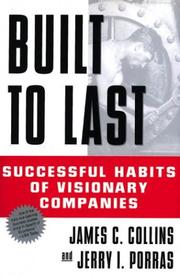
Built to Last and Good to Great are the primary research sources the enduring-company literature builds on and argues with.
Where it sits in the reference 2
Who recommended it 3 · 2 direct
Similar books 6
Chosen by shared topics, the entries that hold them, and the people who recommended both.