Good to Great
Open Library unreachable this run; title not machine-verified.
Summary
Collins and his research team screened Fortune 500 companies for a specific pattern: fifteen years of returns at or below the market followed by a transition point and then fifteen years of returns at least three times the market. Eleven companies met the test, including Kimberly-Clark, Walgreens, Wells Fargo, Gillette and Nucor. Each was matched against a comparison company in the same industry with similar opportunities that did not make the leap.
The findings include Level 5 leadership, which combines personal humility with professional will and describes CEOs who were not celebrity figures. First Who Then What argues that companies got the right people on the bus before deciding where to drive it. The Stockdale Paradox pairs unwavering faith in eventual success with confronting present facts. The Hedgehog Concept identifies the intersection of what you are deeply passionate about, what you can be best in the world at, and what drives your economic engine, expressed as profit per some denominator. The Flywheel describes cumulative momentum rather than a single transformative event, and Collins contrasts it with the doom loop of repeated new directions.
The research design is the book's central problem. Selecting on the dependent variable means Collins found traits shared by companies that outperformed, without testing whether companies that failed shared them too. Phil Rosenzweig's The Halo Effect argues that the descriptions of culture and leadership were shaped by the known results. The subsequent record is damaging: Circuit City went bankrupt, Fannie Mae required a federal rescue, and Wells Fargo faced a fraud scandal. The Hedgehog Concept and the flywheel remain useful as planning devices rather than as findings.
Key takeaways 8
- The executives who led sustained transformations combined personal humility with intense professional will, and were not the celebrity leaders the business press favours.
- Companies should select the right people before setting direction, because the right people adapt strategy and the wrong people undermine any strategy.
- Leaders must confront the most brutal facts of their current situation while retaining absolute faith that they will prevail in the end.
- A company should operate only at the intersection of what it can be best in the world at, what it is passionate about, and what drives its economics.
- A single economic denominator, such as profit per customer visit or per employee, focuses a company more effectively than multiple metrics.
- Sustained results come from cumulative pushes on a flywheel rather than from a single transformative programme or acquisition.
- Technology accelerates an existing transformation but never causes one, and companies that led with technology did not make the transition.
- Disciplined people, thought and action remove the need for hierarchy, bureaucracy and excessive controls.
Who should read it
Operators who want a vocabulary for transformation and a planning framework, provided they treat the findings as hypotheses rather than as demonstrated causes.
About Jim Collins
Management researcher; Stanford Graduate School of Business faculty 1988-1995, since then an independent researcher running a management laboratory in Boulder, Colorado
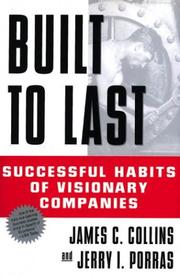
Built to Last and Good to Great are the primary research sources the enduring-company literature builds on and argues with.
Where it sits in the reference 3
Who recommended it 19 · 3 direct
Similar books 6
Chosen by shared topics, the entries that hold them, and the people who recommended both.