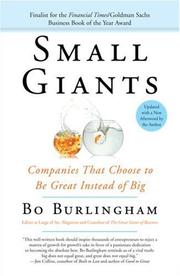
Small Giants
Firms that deliberately chose to be great rather than big.
Summary
Burlingham, an Inc magazine editor, profiles fourteen companies that chose to remain relatively small and privately held rather than pursue maximum growth, and identifies what they had in common. The companies include Anchor Brewing, Zingerman's, Clif Bar, Righteous Babe Records, O. C. Tanner and ECCO.
His central finding is that these companies made an explicit choice to prioritise something other than growth, usually quality of product, quality of working life, relationship with a community, or the owner's control over how the business operates. He calls the resulting quality mojo, and argues that it depends on the owners having consciously rejected the growth default rather than having failed to achieve it.
The common characteristics he identifies include founders who refused acquisition offers and outside capital, deliberate limits on customer acquisition and on geographic expansion, unusually deep relationships with a specific community or location, close attention to the working conditions of employees, and ownership structures designed to prevent forced sale. He covers the financial requirement directly, noting that all of these companies are profitable and that the model requires it, since a business without profit has no alternative to raising capital.
The sample is selected on outcome and Burlingham does not examine companies that made the same choices and failed. The businesses are mostly consumer, craft or service operations where scale provides limited advantage, and the model does not transfer to markets with network effects or capital intensity. The demonstration that the growth default is a choice rather than a requirement is the book's contribution.
Key takeaways 8
- Growth is a choice rather than a requirement, and these companies made an explicit decision to prioritise something else.
- Profitability is the precondition for staying small, since a business without profit has no alternative to raising outside capital.
- Refusing outside capital preserves the owner's ability to make decisions that a financial investor would reject.
- Deliberate limits on customer acquisition and geographic expansion allowed these companies to maintain the quality that distinguished them.
- Deep relationships with a specific community or location provided a defensible position that a larger competitor could not replicate.
- Ownership structures were designed explicitly to prevent forced sale, including arrangements that survive the founder.
- Employees in these companies received unusual attention to working conditions, which the owners treated as the point rather than as a cost.
- The sample consists of businesses where scale provides limited advantage, and the model does not transfer to capital-intensive or network markets.
Who should read it
Owners of profitable private businesses deciding whether to pursue growth or to optimise for control and quality.
Where it sits in the reference 2
Who recommended it 4 · 1 direct
Similar books 6
Chosen by shared topics, the entries that hold them, and the people who recommended both.