Keeping the Family Business Healthy
Growth, succession and ownership planning; the field's first practical manual.
Summary
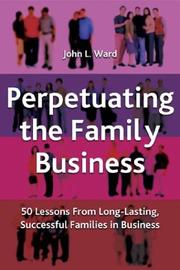
John Ward taught family business at Loyola and later at Kellogg, and this book established much of the field's working vocabulary. Its subject is the specific planning problem faced by a business whose owners are related to each other, where the business strategy and the family's arrangements determine each other.
Ward's empirical starting point is the survival data: roughly thirty per cent of family businesses reach the second generation and about thirteen per cent the third. He argues that the usual explanations, incompetent heirs and family conflict, are symptoms. The underlying cause is that family firms stop reinvesting. A founder builds a business in a growing market, the second generation inherits a mature business with rising owner distributions, capital expenditure falls behind, and the firm loses competitive position at exactly the moment when the family's financial needs are greatest.
His prescription is joint planning. The strategic plan must be developed alongside the family plan, because decisions about dividends, about employing relatives, about ownership transfer and about outside directors all constrain what strategy is available. He sets out the specific mechanisms: written family policies on employment and compensation, boards with genuinely independent directors, formal strategy review, and explicit decisions about whether the family intends to remain owners. The book is from 1987, and its treatment of governance has been extended considerably by later work including Ward's own, but the diagnosis of the reinvestment failure remains the field's central insight.
Key takeaways 7
- Family firms fail because they stop reinvesting, and family conflict is a consequence of declining business performance rather than its cause.
- The second generation typically inherits a mature business whose market has stopped growing, which is a different problem from the one the founder solved.
- Owner distributions and capital expenditure compete for the same cash, and family needs rise as the business's needs do.
- Strategic planning and family planning must be done together, because each constrains the options available to the other.
- Written employment policies for family members, agreed before anyone applies, prevent the disputes that informal arrangements guarantee.
- Independent directors are the single most effective governance mechanism available to a family firm, because they can say what employees cannot.
- Ward argues that the family must explicitly decide whether it intends to remain an owner, since drifting into the next generation forecloses better options.
Who should read it
Owners, advisers and investors dealing with family-controlled companies who want the underlying economic explanation for generational failure and the governance tools that address it.
Where it sits in the reference 2
Similar books 6
Chosen by shared topics, the entries that hold them, and the people who recommended both.