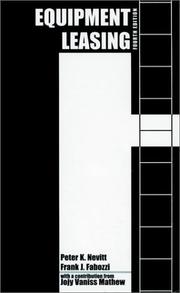
Equipment Leasing
The standard reference on lease structures, residuals and tax treatment.
Summary
The reference has not verified this book in detail; the summary states only what the title, author and subject establish.
Fabozzi and Nevitt produced a practitioner reference on equipment leasing in the United States, covering the structures, the economics and the accounting and tax treatment.
The reference has not verified the detail of the book's chapters. What the authors and subject establish is the territory: the distinction between true leases and conditional sales for tax purposes, the accounting classification between operating and capital leases under the standards then in force, leveraged lease structures in which a lender funds most of the equipment cost on a non-recourse basis against the lease payments, the tax attributes including depreciation that make lessors willing to accept lower nominal returns, residual value risk, and the analysis a lessee performs when comparing leasing against borrowing to buy.
Equipment leasing exists largely because tax benefits and residual value expertise sit better with a specialist lessor than with the equipment user, and because the lessee may prefer to avoid the balance sheet treatment or the residual risk. Nevitt also wrote extensively on project finance, and the leveraged lease structures overlap with that field.
The accounting environment has changed substantially since publication. The current lease accounting standards, effective for public companies from 2019, require nearly all leases to appear on the lessee's balance sheet, which removed one of the historical motivations for leasing. Tax depreciation rules have also changed repeatedly. Readers should verify the current treatment against present standards rather than relying on the book's descriptions.
Key takeaways 6
- Equipment leasing is driven largely by the transfer of tax depreciation benefits to a party that can use them.
- A leveraged lease funds most of the equipment cost with non-recourse debt secured by the lease payments and the equipment.
- Residual value estimation determines lessor economics, because the lease payments alone typically do not recover the full cost.
- The tax distinction between a true lease and a conditional sale determines who claims depreciation and is the structuring constraint.
- A lessee comparing lease against purchase must compare after-tax cash flows rather than nominal payment totals.
- Accounting standards that kept leases off the lessee balance sheet were a historical motivation for leasing and have since been changed.
Who should read it
Practitioners structuring equipment finance who need a reference on lease mechanics, verified against current accounting and tax rules.
About Frank J. Fabozzi
Finance professor and longtime editor of the Journal of Portfolio Management, who writes and edits the standard fixed-income handbooks.
The handbooks define how bond, mortgage and preferred-stock markets are measured: cash-flow mechanics, duration and convexity, credit structures, and the pricing conventions desks actually use. Practitioners and CFA candidates work through these volumes to value and hedge the instruments the equity literature skips.
Where it sits in the reference 3
Similar books 6
Chosen by shared topics, the entries that hold them, and the people who recommended both.