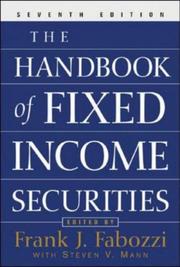
The Handbook of Fixed Income Securities
The desk reference for every instrument in the market.
Summary
This is the standard professional reference on fixed income, edited by Fabozzi and now in its ninth edition, running well over a thousand pages with chapters contributed by practitioners and academics in each specialty.
The coverage is comprehensive rather than pedagogical. Sections cover the instruments in detail: Treasury and agency securities, corporate bonds and their covenants, medium-term notes, commercial paper, high-yield debt, municipal securities, mortgage pass-throughs, collateralised mortgage obligations, commercial mortgage-backed securities, asset-backed securities across the collateral types, and international and emerging market debt. Analytical sections cover yield measures, term structure, duration and convexity in their various forms, option-adjusted spread, prepayment modelling, credit analysis and credit models. Portfolio sections cover indexing, active strategies, liability-driven investing, immunisation and performance measurement. Derivative sections cover futures, options, swaps, caps, floors and credit derivatives.
Because chapters are written by specialists, the depth on individual instruments exceeds what a single-author textbook provides, and the coverage of structured products in particular is the most complete available in one volume.
The format also produces the weaknesses. Chapters vary in quality and in level, there is repetition across contributors, and the whole is a reference rather than a book to read through. It describes industry practice rather than criticising it, and readers should note that pre-crisis editions treat structured products and rating methodologies with the confidence the industry then had. Editions differ substantially and the post-crisis revisions changed the securitisation material considerably.
Key takeaways 7
- Fixed income instruments differ primarily in their cash flow structure and in who holds the embedded options, not in their credit alone.
- Prepayment behaviour makes mortgage security cash flows path dependent, which requires simulation rather than discounting.
- Option-adjusted spread separates compensation for credit and liquidity from the value of embedded options.
- Corporate bond covenants determine recovery and are part of the security's analysis rather than a legal detail.
- Municipal securities carry credit, tax and call features that require analysis specific to the sector.
- Liability-driven investing matches asset and liability sensitivities rather than pursuing return against a market benchmark.
- Asset-backed structures differ by collateral type, and the analysis of each depends on the behaviour of the underlying borrowers.
Who should read it
Fixed income professionals who need a comprehensive single-volume reference across instruments, analytics and portfolio methods.
About Frank J. Fabozzi
Finance professor and longtime editor of the Journal of Portfolio Management, who writes and edits the standard fixed-income handbooks.
The handbooks define how bond, mortgage and preferred-stock markets are measured: cash-flow mechanics, duration and convexity, credit structures, and the pricing conventions desks actually use. Practitioners and CFA candidates work through these volumes to value and hedge the instruments the equity literature skips.
Where it sits in the reference 3
Similar books 6
Chosen by shared topics, the entries that hold them, and the people who recommended both.