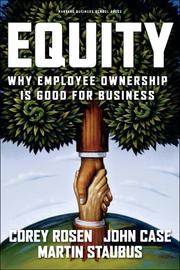
Equity: Why Employee Ownership Is Good for Business
The NCEO's evidence on when shared ownership raises performance.
Summary
Rosen, who founded the National Center for Employee Ownership, with Case and Staubus, argued from research and case evidence that employee ownership improves company performance when it is combined with participative management.
Their central empirical claim is conditional and is the book's most useful contribution. Employee ownership alone produces little measurable effect on performance. Participative management practices alone produce modest effects. The combination produces substantially larger effects, and they present research showing that companies with both grow faster and are more productive than comparable firms with neither. Their explanation is that ownership supplies the incentive and the legitimacy while participation supplies the mechanism through which employees can actually act on information.
The practical content covers the American employee stock ownership plan structure: how it works as a qualified retirement plan, how it can be used to finance a founder's exit with substantial tax advantages, how the shares are valued annually by an independent appraiser, how the repurchase obligation accumulates as employees retire, and how the debt used to establish a leveraged plan is repaid from company cash flow.
They also cover what makes such arrangements fail: ownership treated as a benefit rather than communicated as ownership, employees who do not understand the financial information, management that continues to make decisions the same way, and repurchase obligations that were not planned for and eventually consume the company's cash.
The research is drawn substantially from the authors' own organisation, which advocates for employee ownership, and the causal direction is not established, since well-run companies may be more likely to adopt both practices. The structure described is specific to United States law.
Key takeaways 7
- Employee ownership alone produces little performance effect, and participative management alone produces only modest effects.
- The combination of ownership with participative management produces substantially larger effects than either alone.
- Ownership supplies incentive and legitimacy while participation supplies the mechanism through which employees can act.
- An employee stock ownership plan can finance a founder's exit with substantial tax advantages under United States law.
- The obligation to repurchase shares from departing employees accumulates over decades and must be funded in advance.
- Employees who do not understand the company's financial information cannot act as owners regardless of what they hold.
- Ownership communicated as a retirement benefit rather than as ownership produces none of the behavioural effects.
Who should read it
Owners considering employee ownership and operators implementing it who need the conditional evidence and the funding obligations involved.
Where it sits in the reference 2
Similar books 6
Chosen by shared topics, the entries that hold them, and the people who recommended both.