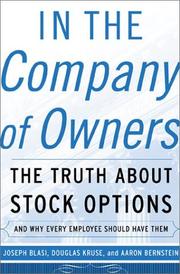
In the Company of Owners
Broad-based stock options and what they did to company performance.
Summary
Joseph Blasi, Douglas Kruse and Aaron Bernstein examine broad-based employee stock options in American companies, particularly in technology, and argue for extending the practice across the economy. Blasi and Kruse are labour economists at Rutgers who have studied employee ownership for decades, and the book combines their empirical work with reporting on specific firms.
The empirical core compares the hundred largest technology companies of the late 1990s with the broader corporate population. The authors find that the technology firms granted options far more widely, that a substantially larger share of the option value went to non-executive employees, and that these firms outperformed on several measures. They argue this partnership capitalism, in which employees hold meaningful equity and participate in decisions about their work, explains part of the performance difference. They contrast it with the pattern in most large companies, where option grants concentrate at the top and function as executive compensation rather than as shared ownership.
The timing is a problem. The book appeared in 2003, drawing on data from a period whose technology valuations were later shown to be inflated, and the accounting change requiring options to be expensed from 2006 substantially reduced broad-based granting. The causal claim is also hard to establish: firms that grant options widely differ from other firms in many ways. The authors are advocates and acknowledge it. The policy chapters proposing tax treatment favouring broad-based plans remain relevant to founders designing equity programmes.
Key takeaways 7
- Technology companies of the 1990s distributed option value far more widely across their workforces than the rest of corporate America did.
- Broad-based ownership improves performance only when it is combined with actual participation in workplace decisions.
- Concentrating equity grants among senior executives converts an ownership mechanism into an ordinary compensation scheme.
- Employees holding meaningful equity supply monitoring of their peers that management cannot buy.
- The authors argue that tax policy should favour plans that distribute equity broadly over plans that concentrate it.
- Employee ownership does not require workers to bear undiversified retirement risk if the equity sits outside the pension plan.
- The productivity advantage the authors measure survives controls for industry and firm size, though not for selection into the practice.
Who should read it
Founders and boards designing equity compensation who want the empirical case for distributing ownership widely rather than concentrating it.
Where it sits in the reference 2
Similar books 6
Chosen by shared topics, the entries that hold them, and the people who recommended both.