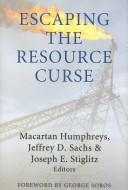
Escaping the Resource Curse
Norway is the counterexample the whole volume is arranged around.
Summary
Humphreys, Sachs and Stiglitz edited this volume of contributions on how resource-rich developing countries can avoid the outcomes that resource wealth usually produces.
The problem is established first. Countries with large natural resource endowments have on average grown more slowly than comparable countries without them, and have exhibited worse governance, more conflict and greater inequality. The mechanisms identified in the literature include real exchange rate appreciation damaging other tradeable sectors, revenue volatility transmitted into fiscal instability, revenue that funds the state without taxation and therefore removes accountability, and the concentration of rents that makes capturing the state more attractive than producing anything.
The volume's contributions address each stage of the resource chain. Contract negotiation and auction design determine how much of the rent the state captures, and the contributors argue that auctions with well-designed rules outperform negotiated contracts and that many developing country contracts were signed on terms far below what the resource was worth. Taxation design determines how revenue responds to price changes, and the contributors examine the trade-off between royalties, which provide revenue certainty, and profit-based taxes, which capture more of the upside. Revenue management covers stabilisation funds, fiscal rules and savings for future generations. Transparency covers publication of contracts and payments, including the Extractive Industries Transparency Initiative. Distribution covers direct transfer of resource revenue to citizens as an alternative to state spending, which several contributors advocate.
The volume is academic and policy-oriented and the contributors do not agree with each other on every question. It was published in 2007 and the subsequent commodity cycle tested several of the recommendations. The contract negotiation and auction design material is the most directly usable.
Key takeaways 7
- Resource-rich countries have on average grown more slowly than comparable countries without large endowments.
- Resource revenue funds the state without taxation, which removes the accountability that taxing citizens creates.
- Concentrated resource rents make capturing the state more profitable than producing anything, which redirects a country's talent.
- Well-designed auctions capture more of the resource rent for the state than negotiated contracts do.
- Royalties provide revenue certainty while profit-based taxes capture more of the upside, and the choice is a genuine trade-off.
- Publishing contracts and payments changes behaviour by making the terms visible to citizens and to competitors.
- Distributing resource revenue directly to citizens is proposed as an alternative to state spending, and it changes the accountability relationship.
Who should read it
Policymakers and investors in resource-dependent countries who need the practical design questions at each stage from contract to revenue distribution.
About Joseph E. Stiglitz
Professor at Columbia University, Nobel laureate in economics, former World Bank chief economist and chair of the Council of Economic Advisers.
Globalization and Its Discontents documents from inside the institutions how IMF conditionality worked during the Asian and Russian crises, and why capital-account liberalisation ran ahead of the safeguards that would have made it survivable. The information-economics argument beneath the later books explains why markets with unequal information do not clear at efficient prices.
Where it sits in the reference 2
Similar books 6
Chosen by shared topics, the entries that hold them, and the people who recommended both.