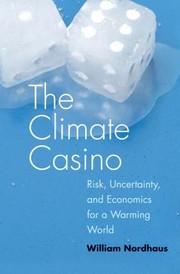
The Climate Casino
The Nobel case for pricing carbon and what a price should be.
Summary
William Nordhaus built the first integrated assessment models linking climate science to economic analysis and later received a Nobel prize for that work. This book presents his framework for a general readership.
The structure moves from the science, presented as the mainstream consensus, through the economic consequences of warming across sectors including agriculture, health, sea level and ecosystems, to the policy analysis. The economic core is the concept of the social cost of carbon, meaning the damage caused by an additional tonne of emissions, which under his framework should equal the price imposed on it. He argues that a carbon price applied universally is far more efficient than sector-specific regulation or subsidy, because it equalises the marginal cost of abatement across every source.
His policy conclusions were controversial from opposite directions. His models produced optimal warming paths substantially above the two degree target that international negotiations adopted, because the discounted damages did not justify the abatement cost in his calibration. Climate scientists and economists including Nicholas Stern and Martin Weitzman criticised the discount rate and the treatment of catastrophic tail risk, arguing that the damage functions understate what is unknown. Nordhaus also argues for climate clubs, meaning coalitions that impose tariffs on non-participants, as the only mechanism that solves the free-rider problem in international agreements. The book is clear and honest about its assumptions, which is what makes the disagreements about it precise.
Key takeaways 7
- A universal carbon price is more efficient than sector-specific regulation because it equalises the marginal cost of abatement across all sources.
- The social cost of carbon measures the damage from an additional tonne of emissions and should determine the price imposed.
- Nordhaus's models produce optimal warming paths above the two degree target, because discounted damages do not justify faster abatement in his calibration.
- The discount rate chosen determines almost the entire policy conclusion, which is why the disagreement with Stern is about ethics rather than economics.
- Climate clubs imposing tariffs on non-participants are the only mechanism Nordhaus identifies that solves the international free-rider problem.
- Damage functions in integrated assessment models are the weakest component and rest on limited empirical evidence.
- Nordhaus argues that uncertainty justifies acting rather than waiting, because the possibility of severe outcomes carries value.
Who should read it
Investors and policymakers who want the economic framework behind carbon pricing stated by its principal developer, with its contested assumptions visible.
Where it sits in the reference 2
Similar books 6
Chosen by shared topics, the entries that hold them, and the people who recommended both.