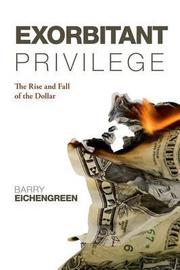
Exorbitant Privilege
The dollar's reserve status and what would end it.
Summary
Eichengreen examines the dollar's position as the dominant international currency: how it acquired that role, what benefits it confers on the United States, whether the position is stable, and what would replace it.
The historical argument corrects a common misunderstanding. Eichengreen shows that sterling's dominance did not end abruptly in 1914 and that the dollar and sterling shared the reserve currency role for decades, which contradicts the assumption that international currency status is winner-take-all and irreversible. He documents the deliberate policy work, particularly the creation of the Federal Reserve and the development of a dollar trade acceptance market, that made the dollar usable internationally in the 1920s.
On the benefits he is specific. The privilege consists of seigniorage on foreign holdings of dollars, lower borrowing costs from foreign demand for Treasury securities, the ability to settle international obligations in one's own currency, and the return differential between American foreign assets and foreign holdings of American assets. He quantifies these and finds them real but smaller than the political rhetoric implies.
On the future he argues the dollar's position is more likely to erode gradually into a multiple reserve currency world than to collapse, and that the greater risk is a domestic American fiscal failure rather than a foreign challenge. He assesses the euro and the renminbi as candidates and finds both constrained.
The book was written in 2011 and its assessments of the euro and renminbi have been tested since, with both remaining less significant than the analysis allowed for.
Key takeaways 7
- International currency status is not winner-take-all, and the dollar and sterling shared the reserve role for several decades.
- The dollar's international role was built deliberately in the 1920s through the creation of the Federal Reserve and a dollar trade acceptance market.
- The benefits of reserve currency status are real but smaller than political rhetoric implies, consisting mainly of seigniorage and a modest borrowing cost advantage.
- The United States earns higher returns on its foreign assets than foreigners earn on their American assets, which sustains its external position despite persistent deficits.
- The dollar's position is more likely to erode into a multiple reserve currency arrangement than to be displaced by a single successor.
- The main risk to the dollar's role is a domestic American fiscal or political failure rather than a foreign challenge.
- The euro is constrained by the absence of a unified safe asset and the renminbi by capital controls and the absence of an independent legal system.
Who should read it
Macro investors who need a careful account of what dollar dominance actually delivers and how international currency positions historically change.
About Barry Eichengreen
Professor of economics and political science at the University of California, Berkeley, and economic historian of international monetary systems.
Golden Fetters established the standard account of the interwar gold standard: fixed exchange rates transmitted deflation across borders, and recovery began in each country only after it left the peg. The later books apply that monetary-history method to reserve-currency status, the euro, sovereign debt capacity and the 2008 policy response.
Where it sits in the reference 4
Similar books 6
Chosen by shared topics, the entries that hold them, and the people who recommended both.