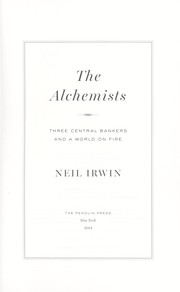
The Alchemists
Bernanke, Trichet and King through the crisis; central banks as FX actors.
Summary
Irwin, then a Washington Post economics reporter, wrote a history of the 2007 to 2012 period told through three central bankers: Ben Bernanke at the Federal Reserve, Mervyn King at the Bank of England, and Jean-Claude Trichet at the European Central Bank.
The historical framing sets up the modern institutions by tracing their origins, from the Swedish Riksbank and the Bank of England's founding through Bagehot's rule that a central bank should lend freely at a penalty rate against good collateral in a panic, and through the Federal Reserve's creation after 1907.
The crisis narrative covers the improvisation. Irwin documents the Federal Reserve's construction of lending facilities against unprecedented collateral, the decision not to rescue Lehman and the arguments about whether it could have, the swap lines to foreign central banks, and the move to quantitative easing. He shows King resisting bank recapitalisation and then designing the British scheme that others copied. He covers Trichet's institutional position: a central bank without a state behind it, prohibited from monetary financing, governed by a council of national representatives, raising rates in July 2008 and again in 2011 as inflation rose while the real risk was collapse.
His general argument is that central bankers held extraordinary discretionary power, that they used it with limited democratic authorisation, and that the crisis was managed by a small number of individuals making judgement calls without a framework.
The book is reported rather than analytical, and Irwin is broadly sympathetic to his subjects, having interviewed them extensively. It was published in 2013 and predates Draghi's later actions, the negative rate era, the taper and the inflation of the 2020s. Tooze's Crashed, also in this reference, covers overlapping ground with more analysis and less sympathy.
Key takeaways 7
- Bagehot's rule that a central bank should lend freely at a penalty rate against good collateral remains the operating doctrine, and every crisis tests what counts as good collateral.
- The European Central Bank operates without a state behind it, which constrains what it can do in a sovereign crisis.
- Trichet raised interest rates in July 2008 and again in 2011 when the actual risk was contraction rather than inflation.
- Central bank swap lines extended dollar liquidity to foreign institutions, which was the largest and least-noticed part of the response.
- The Lehman decision was made under legal and political constraints that the participants understood differently at the time than afterward.
- Crisis management was conducted by a very small number of individuals exercising discretion without a prior framework.
- Central bank independence gives unelected officials power that is defensible in normal times and contested during a crisis.
Who should read it
Investors and operators who want an accessible narrative of how the three major central banks actually behaved during the crisis and why they differed.
Where it sits in the reference 3
Similar books 6
Chosen by shared topics, the entries that hold them, and the people who recommended both.