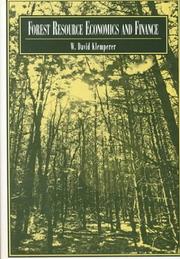
Forest Resource Economics and Finance
Standard textbook on rotation-age valuation and forest finance.
Summary
The reference has not verified this book in detail; the summary states only what the title, author and subject establish.
Klemperer wrote this as a textbook applying economic and financial analysis to forestry. The reference has not verified the detailed contents.
The subject has features that make it analytically distinct. A forest is a capital asset that grows, so the owner's decision is when to harvest, and the answer depends on the growth rate of the standing timber against the discount rate: while the timber grows in value faster than the alternative return on the capital tied up, holding is correct. This is the Faustmann problem, first formulated in 1849, and its solution determines optimal rotation length, which is shorter than the age of maximum biological growth because the land could be replanted and the cycle repeated.
Other territory includes the valuation of standing timber and of forest land; the treatment of a forest as a portfolio of stands of different ages; taxation, which affects rotation decisions substantially; risk including fire, disease, wind and price volatility; the economics of multiple use including recreation, watershed and habitat values that have no market price; carbon accounting; the difference between industrial forestry and non-industrial private ownership, which has different objectives; and public forest management where the objective is not commercial return.
Forest investment has become an institutional asset class since the book was written, with timberland investment management organisations and real estate investment trusts holding what forest products companies previously owned, which changed the ownership structure and the analytical requirements.
Readers should verify the book's specific coverage and supplement it with current material on carbon markets and institutional ownership.
Key takeaways 7
- A forest is a growing capital asset, so the harvest decision compares the timber's growth rate against the return available on the tied-up capital.
- Optimal rotation length is shorter than the age of maximum biological growth, because the land can be replanted and the cycle repeated.
- Taxation affects rotation decisions substantially, so tax treatment changes the physical management of the forest.
- A forest is best analysed as a portfolio of stands of different ages rather than as a single asset.
- Recreation, watershed and habitat values have no market price, which is why private and social optima diverge.
- Fire, disease, wind and price volatility are the risks that determine whether a rotation completes as planned.
- Institutional ownership through timberland investment vehicles has replaced forest products company ownership, which changed the analytical requirements.
Who should read it
Investors and managers in timberland and forestry who need the economic framework for harvest timing and valuation, supplemented with current material.
Where it sits in the reference 2
Similar books 6
Chosen by shared topics, the entries that hold them, and the people who recommended both.