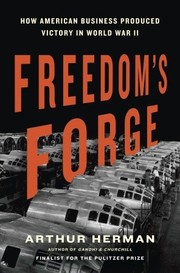
Freedom's Forge
American industrial mobilisation in the 1940s; the precedent everyone reaches for.
Summary
Herman covers American industrial mobilisation for the Second World War through two figures: William Knudsen, the Danish immigrant who ran General Motors production and was recruited by Roosevelt to organise war output, and Henry Kaiser, the construction contractor who built Liberty ships and applied mass production methods to shipbuilding.
The operational content is the interesting part. Herman documents how Knudsen worked by convening industry, allocating subcontracts across many small firms rather than concentrating them, and refusing to nationalise or to direct production by command. He shows Kaiser's shipyards cutting Liberty ship construction time from months to weeks through prefabrication, welding instead of riveting, and hiring and training workers with no prior industrial experience, including large numbers of women and Black workers. The aggregate numbers are the argument: American output of aircraft, ships, tanks and munitions exceeded all the Axis powers combined within about three years.
Herman's thesis is that this happened because the government contracted with private industry on commercial terms and left the production decisions to industrial managers, rather than through central planning. That is a real argument supported by the case, and it is also an ideological position that shapes what the book covers. Herman gives thin treatment to the War Production Board's actual allocation powers, to price controls, to rationing, to the labour movement's role, and to the massive public capital investment through the Defense Plant Corporation. Economic historians would say the mobilisation was far more directed than Herman presents. Read it for the production detail and treat the political conclusion as contested.
Key takeaways 7
- American war production exceeded that of all Axis powers combined within roughly three years, starting from an industrial base configured entirely for civilian goods.
- Knudsen organised mobilisation by distributing subcontracts across many small manufacturers rather than concentrating orders in the largest firms.
- Converting automotive mass production methods to aircraft and munitions required redesigning the products for manufacturability, not merely retooling.
- Kaiser cut Liberty ship construction time from months to weeks through prefabricated sections, welding rather than riveting, and training unskilled workers to a single task.
- Production was achieved by contracting with private firms on commercial terms rather than by nationalising plants or directing output by command.
- Training workers with no industrial background, including large numbers of women and Black workers, was the binding constraint that the shipyards solved by narrowing each job.
- Industrial managers rather than military officers or civil servants made the production decisions, and Herman argues this was the decisive organisational choice.
Who should read it
Operators interested in scaling production quickly and in how a decentralised contracting structure delivered output, with the political argument taken as contested.
Where it sits in the reference 2
Who recommended it 2 · 1 direct
Similar books 6
Chosen by shared topics, the entries that hold them, and the people who recommended both.